Operational leaders from across multifamily gathered to brainstorm, build, and commit to a better brand with humans + AI working together.
SCOTTSDALE, AZ — AI can scale operations quickly, but scale without guardrails can also erode the very experiences operators work hardest to build.
At Forum, multifamily leaders representing owner-operators, third-party managers, and centralized leasing teams, joined an Operational AI workshop to explore how automation can responsibly support leasing, marketing, and resident communication without compromising service, trust, or brand identity.
Led by Laurel Zacher, a 33-year veteran of multifamily marketing leadership, including seven years at Security Properties Residential as Vice President of Marketing and Customer Engagement, and her 2024 stint as the NMHC/RETTC Chair of Marketing and Resident Engagement Committee. Now founder and CEO of her own consulting firm LZ strategies, Zacher brought her vision to a Forum workshop designed to challenge attendees to think critically about how AI fits into real operational environments.
At the end of the three-hour workshop, small groups worked in teams to discuss challenges, surprises, and opportunities before presenting their findings.
Breakout 1: Say the hard stuff out loud
The conversation around AI in multifamily operations has moved well past “if” and into “how.” And more importantly, “how do we do this responsibly?”
Zacher shared that every organization needs to define a clear line: AI is allowed to ___, but a human must always ___. Without that guardrail, teams risk handing over too much or pulling back too far. The operators in the room agreed, if you don’t define this upfront, AI decisions will get made for you instead of by you.
In the first breakout session, teams discussed three fill-in-the-blank statements about their organization’s experience with AI—the good, the bad, and the ugly.
- AI failed us when it _______ because _______.
- AI surprised us (good or bad) when it _______.
- The thing nobody says out loud about AI in our org is _______.
Four teams presented their findings, uncovering similarities between each response.
Where AI needs more work
Teams agreed the biggest challenge with AI is the knowledge gaps about specific pieces of your community offerings.
“You don’t know what you don’t know, and neither does AI,” Zacher said.
But it went deeper than that. Teams said AI struggles when it doesn’t have full visibility into conversations, especially when key information happens offline, in a phone call, or across disconnected systems, and defaults to quick answers instead of asking better follow-up questions. While it surfaces correct information, the situation may require more emotional nuance than AI is capable of providing.
“A real person knows you have to go back and forth, but AI just wants to give you an answer right away, without understanding the nuance of the request,” an attendee said.
The consensus: AI failed us when it lacked context, relied on incomplete or poor-quality data, and delivered fast, confident answers without fully understanding the situation.
AI surprised us when
AI is most powerful when it accelerates work in ways teams can actually feel.
For example, Zacher recalled in the early days of Google Translate how difficult it was to trust translations. Today, that’s no longer the concern. Attendees shared that language capabilities are now seamless, removing barriers in ways that weren’t possible before.
Another team pointed to speed as the biggest unlock for AI workflows in their community.
“It surprised us when AI workflows got an application to lease done in 20 minutes,” they said.
AI surprised teams by driving real speed and efficiency across the entire journey, not just at the top of the funnel, but throughout leasing, resident workflows, routing, collections, and even language accessibility.
No one talks about
AI isn’t plug and play. It requires effort, ownership, and ongoing input to actually perform, both from your team, your onsite team working in partnership with your AI, and your AI supplier partner.
“You have to nurture and feed [your AI]…,” one attendee said. “That’s how we think about managing AI knowledge.”
The consensus: AI only works as well as the effort behind it. It needs structured data, ongoing training, and active ownership, and it changes the work just as much as it saves time.
Breakout 2: AI as assistant, not replacement
The second breakout shifted from reflection to application. Teams were asked to classify work across three categories: what AI can own, where AI assists, but humans lead, and what should remain human-only.
What stood out immediately was how much time exists in the “assist” category.
What AI can own
Across every table, repetitive outreach rose to the top. Follow-ups, renewal reminders, tour scheduling, rescheduling, and application nudges are happening daily and at scale.
“Renewals are one thing that people don’t talk about enough that takes the most time,” one team said. “I think each renewal takes about 1-2 hours, and doing 10-20 per month, it’s a huge chunk of time.”
AI is already proving valuable here, handling consistent outreach, answering common questions, sharing links, and guiding renters through next steps. What used to be manual, like handwritten renewal follow-ups, has already been automated. AI is the natural next step.
What AI + humans team up on
This is where most of the nuance lives, and the future of how AI will shift multifamily operations the most.
Teams pointed to areas like responding to reviews, managing conversations, and guiding renters through decisions. AI can generate responses, personalize outreach, and keep things moving, but humans still refine the message, add empathy, and make judgment calls.
The common thread: AI speeds things up, but humans make it better.
Even in more operational workflows, like renewals or move-outs, AI can initiate the process, gather information, and move things forward, but there’s still a need for human oversight before anything is finalized.
Just as important, however, is how the work transitions between AI and human teams. A smooth handoff requires clear triggers that signal when a conversation or task should move to a human (and routing to the right human or specialized team), whether that’s complexity, sentiment, compliance risk, or a key decision point.
What your team should own
Moments that require judgment, empathy, or physical presence stayed firmly human. Handling a notice to vacate, identifying opportunities to retain a resident, or catching something like the smell of a unit are all things AI can’t fully replicate.
Some operators shared that some of these tasks could be handled autonomously as they learn to trust AI, but they are not there yet. But gradually, as confidence builds and systems prove themselves.
“At some point when you watch all of these new technologies come out, and you watch everyone else use it, you start to see it’s not so bad,” Zacher said. “If you’ve ever ridden in a Waymo, your first time you were probably scared. I’m in the back seat and there’s no driver, but after I started using it, now I love it.”
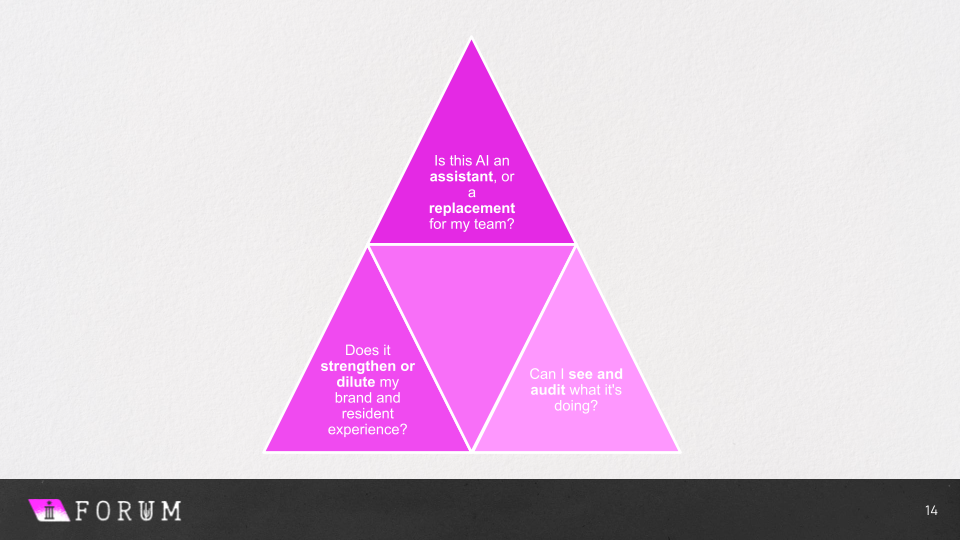
Takeaway: AI gut check triangle
Zacher presented a simple framework to evaluate whether a solution actually fits your operations. Before adopting any AI, teams should be able to clearly answer three questions:
- Is this AI acting as an assistant or a replacement?
- Can we see and audit what it’s doing?
- Does it strengthen or dilute our brand and resident experience?
If you can’t confidently answer all three, the issue isn’t the technology, it’s the design. The goal isn’t just to implement AI, it’s to ensure it aligns with your workflows, your goals, and how your teams actually operate.
“I use this regularly,” Zacher said. “Because AI might just be doing what it is designed to do. You have to change the process to understand if you are choosing the right AI to solve the problem, and if the AI aligns with your organization’s operational goals.”
Brand breakout: Can AI tell your brand story?
The final breakout pushed teams to test something simple but revealing: if a prospect asked AI whether your community is worth the rent, what would it say?
Using real properties, attendees compared how AI actually answered versus how they wanted it to answer. They asked various LLM models from ChatGPT, to Claude, and Gemini, and the gap was eye-opening.
AI pulled from reviews, ratings, and public data sources like Google, Yelp, and even Reddit, often prioritizing those over a property’s own website. In some cases, different models returned completely different narratives based on where they sourced information and how the prompt was framed.
“Your brand story no longer lives in your tagline or marketing copy. It lives in the data AI can find, verify, and summarize,” Zacher said.
At the end of the discussion, attendees all agreed that performing a similar audit regularly to ensure LLMs are finding the right information and showcasing their properties accurately and in the right light.
Team conclusion: AI is allowed to….
Across every breakout, the patterns were hard to ignore. Different teams, different portfolios, different levels of AI maturity, but the same core themes kept surfacing. Clear boundaries, better data, defined ownership, and thoughtful design showed up as the difference between frustration and real impact.
There was also strong alignment around the role AI should play. Not as a replacement, but as a force multiplier. The most effective use cases were the ones that removed repetitive work, accelerated timelines, and created space for teams to focus on judgment, empathy, and experience.
And perhaps most importantly, every session pointed back to accountability. AI is already shaping how prospects evaluate communities, how teams operate, and how brands are perceived. The teams getting this right are designing intentional handoffs, with clear triggers and smart routing that ensure the right person steps in at the right moment, with full context. Because that transition is where the experience is either elevated or lost.
Zacher left the group with a list of ideas to take back to their teams to implement better AI operational workflows:
- Identify one assistant-style AI use case to pilot or improve
- Commit to one audit habit over the next 90 days
- Define one brand or value question you want AI to answer well
- And most importantly, put their AI commitment to work.
The group aligned on a shared statement:
AI is allowed to inform, contribute, and deliver timely, accurate information, but a human must validate, apply judgment, and own the experience, especially in legal, compliance, and high-empathy moments.
Their AI commitment statement emphasized that the future of multifamily is not AI only, it is AI + humans working together to operate more efficiently and improve the renter experience.