BH leaders share how a service philosophy became a centralized operating model powering leasing, renewals, and resident accounts across more than 93,000 homes.
SCOTTSDALE, AZ — BH didn’t set out to centralize simply for the sake of efficiency. They set out to deliver wildly awesome service. The Mint Experience became the standard, built around a simple idea: if the experience is better for renters, it should be better for the teams delivering it, too. Financial results will follow.
Ranked No. 13 on the NMHC Top Managers list, and 37 on the owners list, BH manages more than 93,000 units across 42 states, spanning both ownership and third-party management. As the company scaled, leadership began asking a bigger question: how do you deliver a consistent, high-touch resident experience across thousands of interactions and hundreds of communities?
The answer became The Mint Experience.
At Forum, Christi Weinstein, Chief Operating Officer, Amy Walling, Unified Strategic Services Senior Project Manager, Amy Davis, Vice President of Shared Services, and Andre Washington, Director of Contact Center Technology, shared how that vision evolved into an operating model that impacts the resident journey, employee satisfaction, and retention.
At the center of The Mint Experience are four pillars of their centralized operating model:
- Contact center
- Applicant screening
- Renewals
- Resident account management
But those pillars didn’t start as a unified system. Each function was built within its own department, creating fragmentation across the experience.
“We really needed to bring [those departments] together to understand the impact of our Mint Experience model, not just for our properties, but for our clients as well,” Weinstein said.
Managing change and The Mint Experience
BH’s approach started with a “lift and shift,” moving existing work off-site first, then iterating and optimizing over time.
But getting there required a change management plan built for scale.
“First thing we do out of the gate at BH with any project, large or small, is we implement the RACI. Just to really remove the ambiguity of who owns what. Who’s responsible, who we bring in along the way into the journey,” Walling said. “We spent a lot of time mapping workflows, understanding where the handoff happens, where output becomes one team’s input.”
Because of the size and scope of the rollout, BH broke the work into pieces aligned with how the organization already operates.
“We broke it up into a product stack that aligned with our internal organization…and all of our centralized pillars, so we can really leverage those subject matter experts along the way at the right time instead of trying to tackle it all at once,” Walling said.
Communication followed the same philosophy: early, often, and transparent. Eventually, the team landed on a shared services model designed to create consistency, not just across properties but across the entire resident experience.
“We really learned to have the synergies that we just weren't having before,” Davis said. “It allowed us to implement a much more consistent method so that property A isn't getting on top of property B, and the prospects don't have to screen again or vice versa.”
Davis said their recent rollout of Funnel’s intent router has also become her team’s “super power.” If the AI cannot answer a question, the task is automatically handed to the correct team.
“No one is having to filter through the queue and assign out the work, they can just take action,” Davis said. “That’s a super power.”
The result is a model that supports both scale and consistency, while allowing on-site teams to focus on what matters most: delivering great service.
Unified system, single source of truth + seamless renewals
Centralization only works if the system behind it keeps up.
For BH, that meant moving away from a fragmented tech stack and into a single platform that could support the full resident journey. What used to require multiple systems and manual handoffs now lives in one place, creating a shared source of truth across teams.
“It was a huge game changer,” Davis said. “We went from a legacy system where one of the pillars was operating in nine different apps or software…to making Funnel the source of truth for communication and all things.”
With everyone operating in a single platform, information flows across the entire organization. What a contact center agent captures is immediately visible to onsite teams. What happens during a renewal conversation reflects prior interactions. Nothing gets lost between handoffs.
“The fact that we’re all working in one unified platform…the fluidity of that information is a game changer,” Weinstein said. “Before, it was a fragmented experience, not just for the resident, but for the employee.”
That fragmentation showed up elsewhere, too. Teams working in legacy systems felt the gap immediately, especially as others transitioned into a more modern, centralized platform.
“They were begging,” Weinstein said. “We’re ready, we’re ready, we’re ready.”
Because once teams experience what it feels like to operate with full context, it’s hard to go back. Funnel’s renter-centric® architecture and single guest card, provide a 360° view of the renter journey, no matter where teams are located.
That context becomes especially powerful in moments that matter. A renewal specialist can see prior interactions, sentiment, and friction points before picking up the phone, and adjust the conversation in real time. Instead of jumping straight into pricing or terms, they can start with a check-in, acknowledge concerns, and rebuild trust.
It’s not just about having the data. It’s about making it usable across every role in the system.
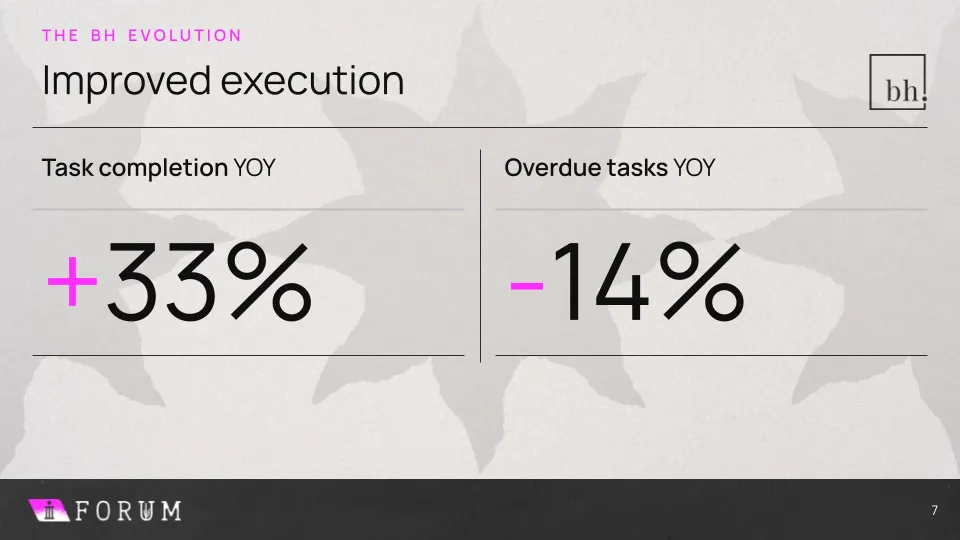
And the results show up in execution. Task completion increased 33% year over year, while overdue tasks dropped 14%.
Because when the system is unified, the experience becomes consistent—for both the team delivering it and the resident on the other side.
Contact center: The front door of The Mint Experience
The contact center sits at the center of this model, acting as the “front door” to The Mint Experience. It’s where speed, personalization, and technology come together to shape the first impression, and increasingly, the entire leasing journey.
The BH contact center leverages Funnel’s prospect AI and VoiceAI to manage the top-of-funnel traffic before handing off to the highly-skilled contact center team.
With AI supporting initial interactions and centralized teams handling more complex conversations, BH fundamentally changed how prospects move through the leasing funnel. Not to mention, the flexibility allows the team to provide personalized service to a broad audience, while offering a modern, e-commerce-style experience renters expect.
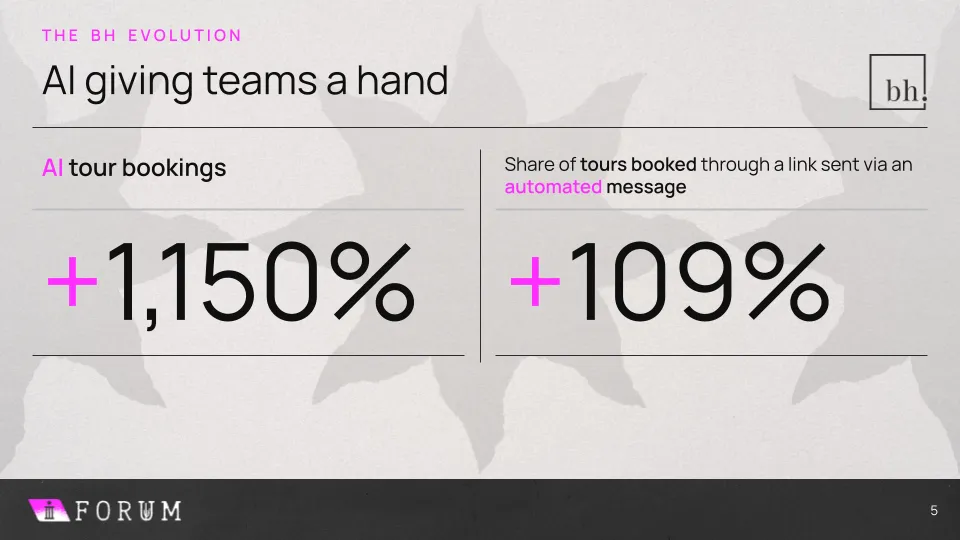
Tour bookings increased 150% overall, including a 1,150% increase in tours booked by the AI assistant and a 109% increase through automated scheduling links year over year.
The strategy is simple: meet renters where they are. For some, that means quick, self-service answers. For others, it means a deeper, more consultative conversation. At BH, the experience offers both.
“If someone’s hungry we have the option of a nice vending machine, so whenever you need it really quickly, it’s there,” Washington said. “But you can also have the option of a nice sit-down meal, just press one, and you get a human.”
By giving prospects both paths (and making the transition between them seamless) BH is able to move faster without sacrificing the human connection that drives conversion.
“Our strategic approach is to be calibrated to be able to serve both of those individuals, and to be able to serve a multitude of needs,” Washington said.
Voice AI: Volume handled, experience preserved
If applicant screening removes friction mid-funnel, voice AI ensures it never builds in the first place.
For BH, voice AI plays a critical role in managing volume without compromising experience. It handles the repetitive, high-frequency interactions that traditionally overwhelm onsite teams, creating space for humans to step in where it actually matters.
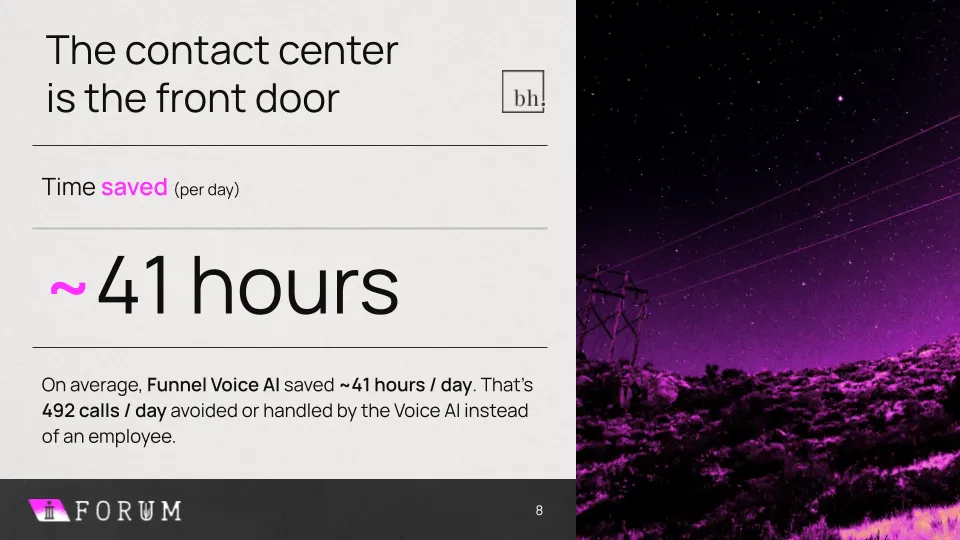
Today, AI manages hundreds of calls per day, saving approximately 41 hours of work daily for the call center team.
With AI handling initial inquiries, agents no longer feel pressure to rush through conversations or clear a queue. Every call that reaches a human is more intentional, more complex, and more valuable.
“Having the AI in place really does reduce our workflow and our volume,” Washington said. “It gives us a mental shift where they know every contact they're coming in contact with has been nurtured strategically.”
The result is a better experience on both sides. Renters get faster answers when they want speed, and more thoughtful conversations when they need support. Teams get the capacity to focus on quality instead of throughput.
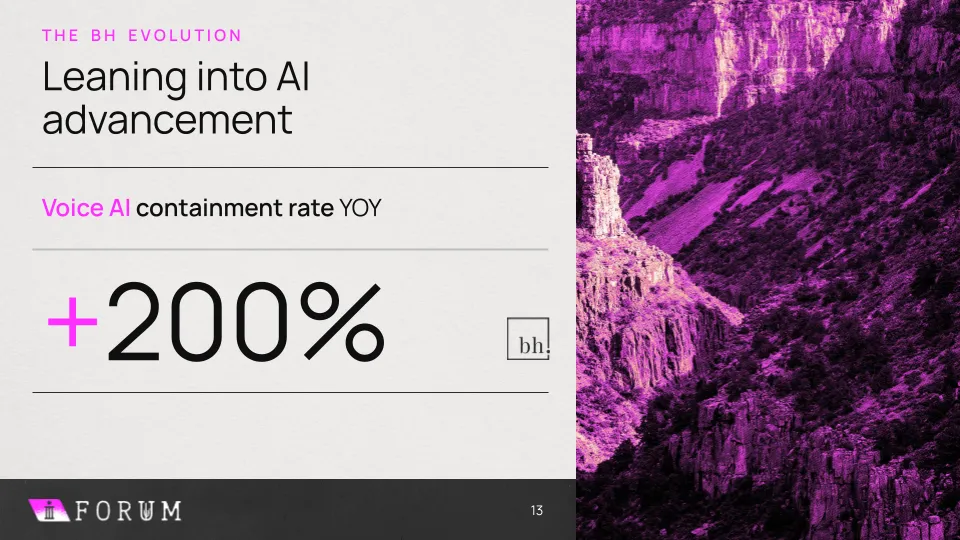
Another signal of how well this is working is containment. BH saw containment rates increase by more than 200%, meaning significantly more conversations are fully resolved within AI without needing to escalate.
That ties directly back to the “vending machine” approach. When the option is fast, reliable, and actually delivers, renters don’t feel the need to press for a human. They get what they need and move on.
It’s a strong indicator that self-service isn’t a fallback anymore, it’s a preferred path for a growing share of renters.
Resident account management: Creating a wildly awesome employee experience
For years, onsite teams have operated as generalists, expected to do everything at once: answer calls, manage tours, handle resident issues, process applications, and keep the property running. The result is predictable—constant context switching, burnout, and work that rarely gets the attention it deserves.
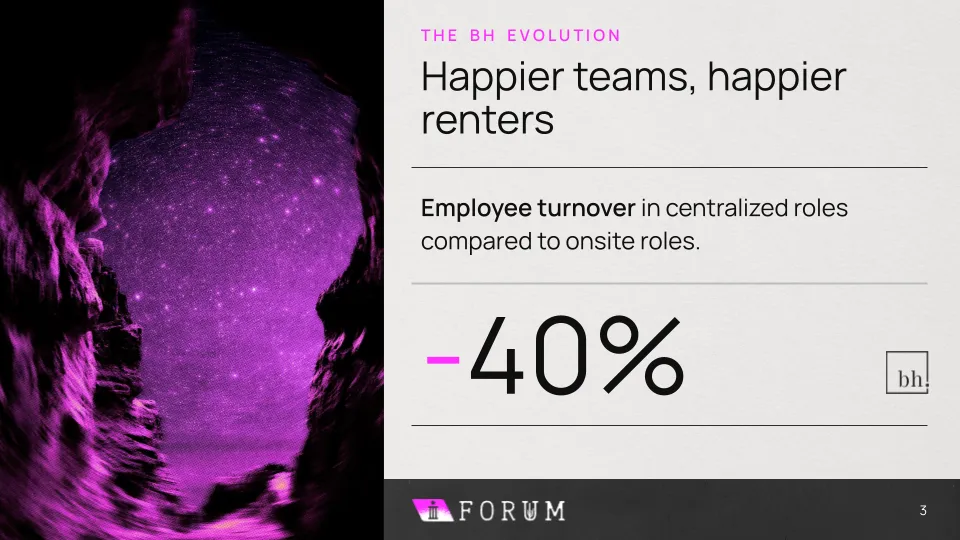
By shifting from generalist on-site roles to specialized centralized positions, BH created clearer ownership and more focused workflows, leading to a 40% reduction in employee turnover in centralized roles.
Just as important: these aren’t new hires learning the business from scratch. Nearly all centralized team members previously worked onsite at a BH property. They understand the resident journey because they’ve lived it. Now, they’re applying that experience in more focused roles (that also happen to be fully remote), improving work-life balance and reducing burnout.
“[We gave them a] streamlined workflow and focus that's really allowed them to hone in and find a place where they feel they can contribute to the organization,” Washington said. “Employee satisfaction has really just gone through the roof on my team because they are in a place where they feel most comfortable. They don't feel they're deviating from their talents and their confidence.”
These “boots on the ground” team members are the secret ingredient to achieving the true Mint Experience. As former generalists, moving onsite teams to specialized roles helps them focus their skills rather than being spread thin.
“When everything’s important, nothing is really getting the traction that it needs mentally,” Weinstein said. “AI and leasing agents are coming together to make it a much better experience. It empowers them to do their best work and you’re taking a comprehensive approach to make it a lot easier, and better for everyone.”
Screening: Removing application friction
If the contact center is the front door, applicant screening and online leasing are where momentum is either maintained…or lost.
For years, the industry took a pen-and-paper process and made it more complicated with digital technology, with more steps, more back-and-forth, and more opportunities for drop-off. And for onsite teams, it meant juggling systems instead of moving renters forward.
For BH, The Mint Experience ethos and move to Funnel changed that.
By pairing a dedicated screening team with Funnel’s Online Leasing platform, BH standardizes decision-making, reduces risk, and moves faster without sacrificing accuracy. The experience becomes more predictable for operators and more transparent for renters.
The impact showed up quickly.
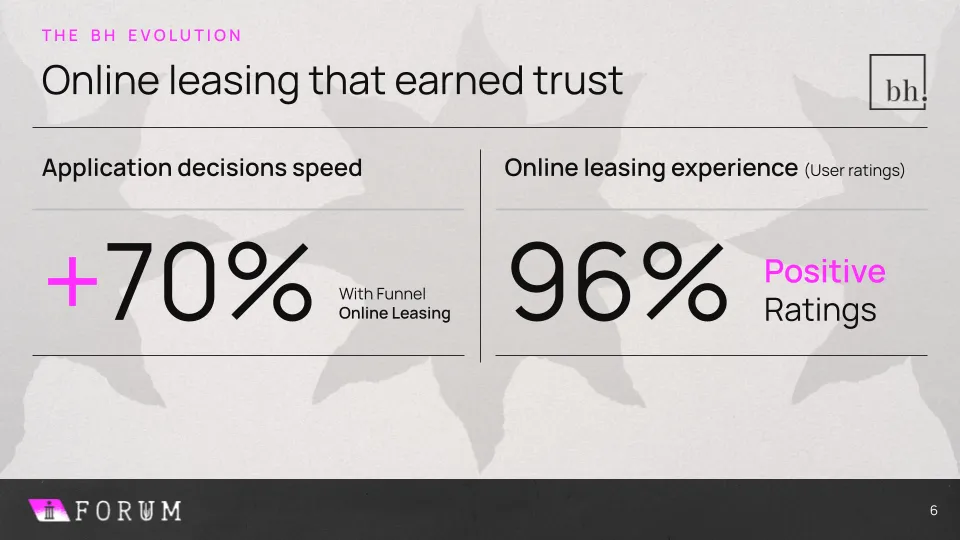
96% of renters now rate their online leasing experience through Funnel as positive, and application decisions happen 70% faster.
That speed isn’t just operational efficiency; it directly affects conversion. When renters are ready to move forward, delays create doubt. Faster, more consistent approvals keep that intent intact.
It also reinforces the broader goal of The Mint Experience: removing administrative burden from onsite teams so they can stay focused on high-value interactions, while centralized teams and technology handle the rest.
Because at this stage of the journey, consistency matters just as much as speed.
BH: Built to scale, designed to adapt
Like nearly every other operator, BH’s approach to centralization is still a work in progress. The Mint Experience didn’t come from a single initiative. It came from aligning structure, technology, and people around a shared goal.
Centralization created the foundation. A unified system made it actionable. AI scaled it. And the people behind it brought it to life.
“I don’t think there’s an end to centralization,” Weinstein said. “It’s about continuing to iterate on what we’ve already built and expanding what we can bring into that model.”
It’s not a one-time transformation. It’s an operating model that evolves over time, shaped by new tools, new expectations, and a clearer understanding of where teams add the most value.
And while every operator’s path will look different, the direction is becoming clearer.
Centralize what you can. Support it with the right system. Use AI to scale it. And keep refining.
Because the goal isn’t just efficiency. It’s delivering an experience that actually feels consistent, for every renter, every time.