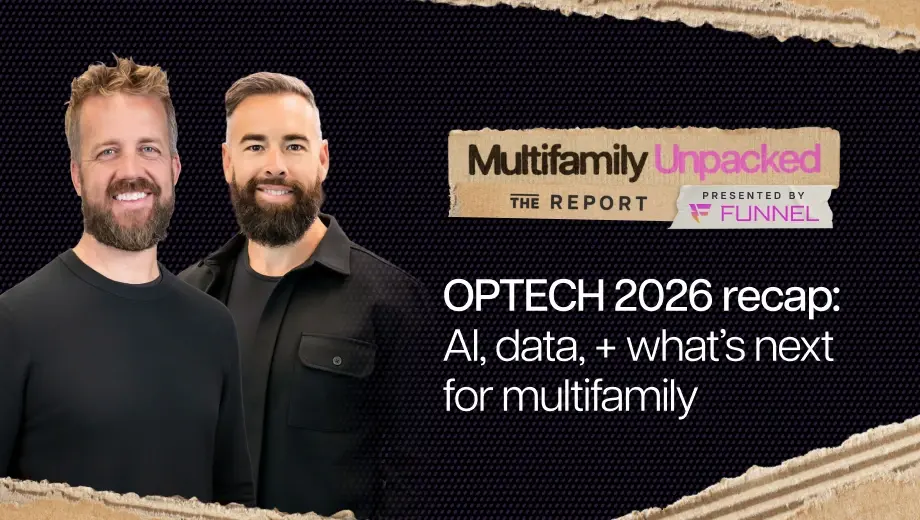
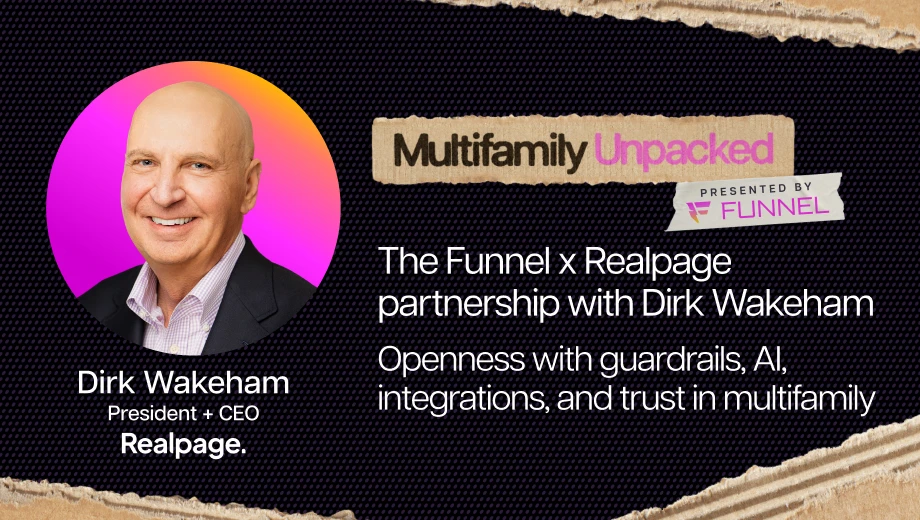
Fresh off OPTECH 2026, Alex Howe, SVP of Marketing + Growth at Funnel, and Tyler Christiansen, CEO of Funnel, recap the conversations shaping multifamily’s future. They discuss how AI was, of course, everywhere at OPTECH 2026, but the conversation’s changing. Operators are asking how to access more of their data, keep it clean, put it to work, and help their teams perform at their best.
In this episode:
— Why access to clean, connected data is becoming an AI priority
— How operators can use AI to support and coach their teams
— What an open technology ecosystem means for operator choice
— The latest news on market fundamentals, technology strategies, and housing policy
Watch the full episode on YouTube, listen on Spotify, Apple podcasts or wherever you get your podcasts. Keep reading for the full transcript.
Introduction: The Funnel booth and new announcements
Alex Howe, SVP Marketing + Growth, Funnel:
AI was of course everywhere at OPTECH 2026, but the conversation’s changing. Operators are asking how to access more of their data, keep it clean, put it to work, and help their teams perform at their best.
Welcome back to The Report. Today, Tyler and I unpack what we heard in Vegas this year and the latest headlines on market fundamentals, technology choices, and housing policy. Let’s get into it.
This is fresh off OPTECH 2026, and for those of us whose flights actually took off, many of us just got back from Vegas. If you didn’t feel like you were conducting your own orchestrated rental experience, you somehow missed our booth.
That was the theme. You can now orchestrate many of your tools from within Funnel, so we really leaned into the greatest show in multifamily and gave folks very cool little conductor batons. Thus far, I haven’t heard of anybody getting flagged by TSA for bringing one home.
In case you missed it, we also announced a new predictive renewal insights tool and some broader AI-powered resident sentiment tools that help operators identify issues, focus their teams, and trigger timely action from people and AI to strengthen relationships and prevent avoidable move-outs.
We also announced a ton of new Funnel Fabric partnerships, including our partnerships with Realpage, Zillow, Court, HappyCo, Resi, SweetSpot, and Snappt.
But Tyler, let’s get into what people were actually talking about in the sessions and in the meetings in between. What kept coming up in your conversations with operators this year?
Data, AI, and access to insights
Tyler Christiansen, CEO, Funnel: Alex, the first obvious thing was data. We had so much talk about data. I would not have thought, coming into this industry 10-plus years ago, that I’d be on a stage talking with operators about cleansing and standardizing data.
It’s a big deal because, in the world of AI, the customer of our customer, in many cases the asset manager, wants access to that data. They’re looking for any little insight into how they can outperform from one property to the next.
Whether it was Fabric and Funnel’s ability to connect to various vendors, like RealPage and Zillow, or orchestration to say, “Hey, I have this data. Now I want to do something with it,” all of those technologies were front and center in a way I think is different from previous years.
In the past, AI was really about the widget, the sexy kind of experiment I could run with it.
Now it’s much more, “Hey, I have so much data that AI is giving me and that AI can query. How do I have access to that?” Very specifically, MCP is a big deal, right? Operators, whether they’re an asset manager, a property manager, a vendor, or an investor, understand how to use Copilot, Claude, or OpenAI. But they want access to the data that will allow them to operationalize the insights that they’re...
Alex Howe, SVP Marketing + Growth, Funnel: Yeah, that was very interesting to hear Mick Hicks of Northwood Raven really went deep on the cool ways he’s connected Funnel into Claude and the insights he’s gotten out of it. Now Copilot, what he’s excited about that he can do next there.
We obviously have a strong opinion on the balance between AI and humans, but outside of our perspective, how are operators thinking about that balance on their teams today?
The balance between AI and people
Tyler Christiansen, CEO, Funnel: You’re right. We may be biased here. There’s an increasing number of autonomous vehicles in Las Vegas year over year when we go to OPTECH.
Total aside here: A significant leader at NMHC complained in one of my sessions that there’s only one more year in Vegas, and there was a round of applause for that. So hopefully we can get some different venues, for any NMHC people listening.
But despite the increasing number of autonomous vehicles there, it’s a decreasingly popular notion that autonomous buildings are the future of multifamily. There are still technology companies building for that. Funnel is not one of those.
If you look at this moment in time, as I referenced earlier, customers want the data so they can figure out how to outperform, and that outperformance is coming from humans. AI is fantastic. Fenix is a phenomenal AI agent that Funnel can deploy for you, but it’s not the thing that will give you alpha over the competition down the street. It’s not the thing to combat the three-month concession. That is phenomenal human performance.
Where that shows up is that we saw an increasing number of requests for human insights. You mentioned our AI renewal insights product, or AI renewal sentiment. Our customers love the insights product: the ability to hear how a leasing agent is performing and give them real-time coaching.
That’s a bleeding-edge opportunity. Folks want information, insights, and coaching from AI For their humans rather than AI replacing their teams.
Alex Howe, SVP Marketing + Growth, Funnel: You mentioned the importance of getting full access to your data and being able to analyze it in different ways. What were some of the operators talking to you about in terms of the challenges of actually getting useful data across their tech stack?
Open data, MCP, and technology ecosystems
Tyler Christiansen, CEO, Funnel: Yeah, I thought it was interesting. I’m fortunate to sit on the RETCS integration committee, and we had a presentation from a neutral third party who observed that some PMSs have made a determination. This person was saying it’s not good or bad.
I don’t understand how it wouldn’t be bad that some property management software vendors have decided they’re not going to build an MCP connector. The argument is that you can get the data inside their system, or they can do a data dump to you.
I think it’s going to become apparent, much like APIs. For a long time, certain vendors didn’t have APIs, or if they had APIs, they weren’t accessible. Customers demand openness over time.
To your question, there’s education happening about modern data infrastructure. Just because there’s MCP doesn’t mean we don’t need BI, and it doesn’t mean we don’t need APIs. But it’s also like, why the heck wouldn’t you? Maybe I could drink Coke every day but still need water, right?
MCP data access, connecting it to the LLMs, is going to be standard operating procedure. Eventually everyone will be forced to do it. It’s more interesting to look at those who do and don’t want to, and ask why they wouldn’t you want to give open access.
Alex Howe, SVP Marketing + Growth, Funnel: There really are two paths that people are taking today. They’re either fully leaning into an open ecosystem, or they’re closing it up and telling you that you’ve got to run all your tests and reports within their platform and trust what they’re giving you.
I can see the advantage of keeping things closed if you can control the entire ecosystem. Apple famously kept its App Store pretty locked down and has eased things over time. But in our world, how do you see that playing out?
Tyler Christiansen, CEO, Funnel: The strongest argument from them, if we’re trying to play devil’s advocate and find a justifiable way to explain this, is what they’ll call AI slop grenades: You start asking an LLM to query your data, and you’re not sure what you’re going to get.
There are solutions to that. There are markdown files and ways to make sure the data is interpreted the right way. I think there is genuine fear among third-party managers in particular that asset managers are going to be asking the wrong questions or coming up with the wrong definitions, but that’s no different than it is today.
Today, when we export reports from Yardi, Entrata, or Realpage, have to do the job of property management and asset management to speaking the same language. And, to your point about Apple, I think the App Store did better as it became more accessible.
Little old Funnel has dozens of apps on the App Store. There is a protocol, there’s a system, there’s a way. Yes, it’s more controlled than Android, but there’s absolutely a way.
Not every MCP server is going to do read and write. If I’m dealing with a ledger, I absolutely have a lot of reservations about letting somebody write from Claude into the ledger. With Funnel, we have the ability to write into tasks, with the correct permissions. So read and write is a framing where you could say we have it, but we’re not going to go open to an extent where we think it could be detrimental.
Where centralization stands today
Alex Howe, SVP Marketing + Growth, Funnel: There’s been a ton of conversation this year around AI. Where does centralization rank in terms of people’s priorities? What’s the general sentiment around it today, and does it change anything about what we think about the concept?
Tyler Christiansen, CEO, Funnel: It’s a really great question. To be honest, it is not a popular concept at the moment. It’s not that it doesn’t work or didn’t work. It has far more to do with the fact that, in an environment where there’s a lack of rent growth and the majority of management companies operate on 30-day contracts, there’s not a big appetite for long-term change management.
My prediction is that it’s going to come back with a vengeance as rent growth comes back and as folks realize that AI is a great tool. It’s here to stay. You should buy everyone at Funnel’s AI products. But they’re also going to recognize that it’s a marginal improvement unless you pair it with aggregated teams.
Aggregated teams and specialized teams are centralization. I’m on the record here saying that maybe only one out of five conversations brought it up, versus 75% of conversations two years ago. It will come back as a key to unlocking additional value.
Take automated renewals, for example. Automated renewals are a great thing, but you still leave over 20% to 40% of the work for a single team. There’s no cost savings on-site when you still leave that much work: 20% of this, 20% of that. The cost savings come when you aggregate that 20% across 10 communities and have a centralized team managing it more efficiently.
Centralization isn’t having its peak moment, but it’ll come back, and it will be the thing that gives operators even more leverage. And especially those...
Multifamily fundamentals and human performance
Alex Howe, SVP Marketing + Growth, Funnel: Let’s get into a couple of news stories that we’ve seen of late. The theme for the first one is better fundamentals in multifamily, but tougher capital markets. Multifamily Executive had an article that focused on operators seeing improved fundamentals even as financing costs and the gap between buyer and seller expectations make deals harder to close.
If it’s harder to grow by buying or building a building, where do you see operators finding the biggest opportunities to improve performance in their portfolios?
Tyler Christiansen, CEO, Funnel: This is not something I would have predicted. We saw a trend, even as rent growth wasn’t there, Alex, where there was more consolidation. Even that has really quieted down over the last six months. I’ll tell you where operators and asset managers are focusing again: human performance.
Everybody wants to know, “How am I performing?” Frankly, it’s the best moment ever to answer those questions. I was fortunate to participate in REBA’s conference. REBA is a fantastic analytics platform, and they had this gentleman who spoke. He’s a Funnel customer, and he’s using the MCP connector that REBA provides. I assume he’s using Funnel’s MCP connector as well.
He was saying it’s not like he’s out of a job now that AI can do so much more. It’s that he’s getting to analysis he never would have gotten to before because he has the time to do so. We are putting a magnifying glass on leasing agent and human agent performance in a way that we’ve never done before.
When you do that, you will see outsized operational results. I think that will continue. But not everyone is doing that, and that’s your opportunity. If the property down the street isn’t doing tour coaching and isn’t using insights to leverage improvements, you’re going to be able to outperform them. That’s where I’m seeing folks focusing now.
Alex Howe, SVP Marketing + Growth, Funnel: That’s a great point about how folks are leveraging AI.
The second article we want to mention was from Rental Housing Journal. The story was that operators are making two bets: AI either replaces people or helps them have more impact, and, in turn, whether to consolidate technology with one provider or keep more of an open stack.
Tyler, if you were an operator making one of these two bets today, what would you look for to make sure you’re keeping control over both your tech and the renter experience?
Consolidation, open systems, and renter experience
Tyler Christiansen, CEO, Funnel: That’s a great question. As a CEO, I have to make technology decisions all the time for our business. I’ve always advised companies to start with their embedded solutions and see the shortcomings. Frankly, I think all of Funnel’s best customers tried to leverage the CRM or AI from their property management software.
In some cases, maybe it works for them. But the vast majority of Funnel customers have come to us because the AI wasn’t good enough, they couldn’t centralize, or it didn’t allow their teams to really outperform. I think it is smart not to have 30 different technologies in the customer workflow. It’s not good for leasing associates. It’s not good for the renters themselves. So there should be some level of consolidation.
But you need to make demands of those core platforms. For most Funnel customers, the core platforms are property management software on the back end and Funnel sitting on top of that. They have to be open. They have to have APIs, and they should publish those APIs. In today’s modern context, they have to have MCP connectors. How many integrations do they give you?
One of the things that’s always interesting at OPTECH, Alex, is which vendors have a lot of friends, and which vendors other vendors speak highly of. I think that tells you so much: “Hey, I’m a self-guided touring company, but I think you should work with Funnel because they have the best integrations.”
You need to balance both of those objectives. Consolidation is not a bad thing, but the further you explore that, the more dependent you are on your core platforms playing nicely with others.
Housing policy and affordability
Alex Howe, SVP Marketing + Growth, Funnel: Final story we’ll cover focuses around the elections we all just went through, there were some national trends that we witnessed, with Republicans losing quite a bit of control in various houses of Congress. But there were also some hyperlocal stories and policies around housing that Multifamily Dive went into depth on.
Voters weighed in on topics like housing funding, taxes, zoning, and permitting, with different outcomes in different states. As housing affordability stays in the spotlight, what should operators be doing to help policymakers understand the connection between the cost of operating housing and the cost of renting it?
I know, Tyler, you spoke with the RETTC folks, who are focused on some of those efforts to influence policy at the state and federal level as well.
Tyler Christiansen, CEO, Funnel: I was very fortunate. Leslie Turner from the Funnel team and I got to sit down with Sharon Wilson Géno. She advocated to us individually at Funnel to continue supporting RETTC. Obviously, we think about RETTC and OPTECH as a conference and where we go to meet with our customers, but they want to do more work to protect our industry.
All of us who are red or blue, but are in the multifamily housing industry, are pro-housing. We recognize it’s a great industry that provides lots of jobs and provides the best housing in the whole world.
The American rental housing inventory is better than anything you can find anywhere. It’s because it’s a business. It’s because you can make a profit on it that investors come in, pour capital in, use great technology, and make it a wonderful experience. Anybody who’s lived overseas knows that.
There’s just nothing like American housing. Even in amazing cities like London and Paris, they pay more for way less. I think the answer to your question, Alex, is first and foremost, we should support RETTC. We should continue to support organizations that are pro-housing, particularly ones that are red-blue. It’s a topic that crosses party lines. You see NIMBYism of all shades. We at Funnel are proud to partner with RETTC.
I do think we all need to be aware of how we operate in our local markets because, if you really take a step back, as you mentioned, on the tide change in politics, affordability is the core reason.
We in the industry know that rental housing affordability is phenomenal right now. Living here in Tampa, in a couple of years my daughters are likely to pay the same in rent that they would pay today. That’s an amazing accomplishment that we as an industry have created by building so much housing, providing quality housing, and trying our best to keep the cost down.
But most people don’t know that. They would assume that it’s getting more and more expensive. Anything we can do to continue to support that model and support organizations helps. At Funnel, we like to support Entryway as well because they’re out there doing pro-social philanthropic work. The title of landlord is disparaging, but in reality these owners and operators are providing a service and trying to do so in a very pro-social, humane way.
Closing
Alex Howe, SVP Marketing + Growth, Funnel: Thanks for listening to this episode of The Report. Thanks for your time, and we’ll catch you guys next episode.