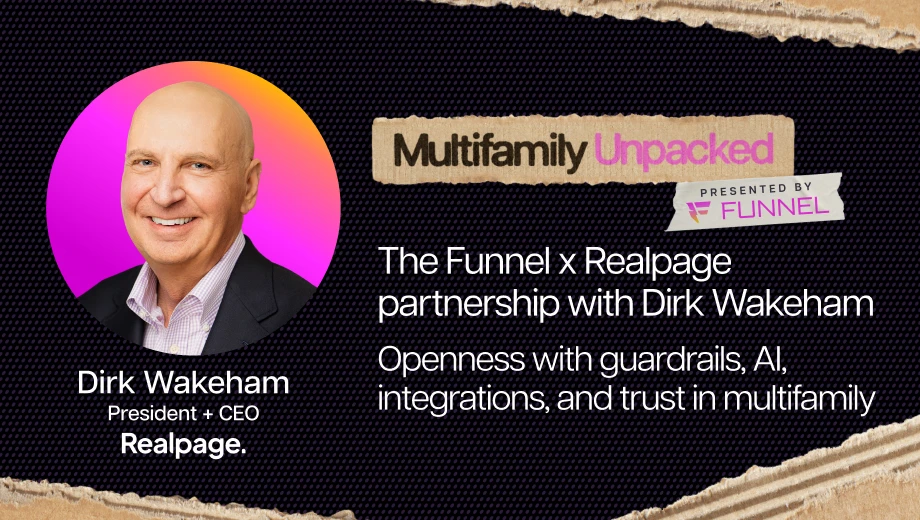
The Funnel x Realpage partnership with Dirk Wakeham — Openness with guardrails, AI, integrations, and trust in multifamily
What happens when two competitors decide to work together? For Funnel and Realpage, it starts with listening to the operators who use both. In this episode of Multifamily Unpacked, Funnel CEO Tyler Christiansen sits down with Realpage CEO Dirk Wakeham to talk about the newly announced historic partnership, why customer choice matters, and what it takes to build trust across multifamily technology.
You’ll hear:
- Why shared customers helped inspire the Funnel x Realpage partnership
- How Realpage’s MCP connector helps operators use their data with AI tools of their choice
- The technical, commercial, and strategic considerations behind integrations
- Why security and governance matter as AI agents gain access to sensitive data
- What a more renter-centric future could look like—and why human judgment still matters
Listen wherever you get your podcasts, Apple, Spotify, watch on YouTube or keep reading the transcript below.
Tyler Christiansen, CEO, Funnel: All right, Dirk, welcome to the podcast. I’m really enjoying this. Let’s talk about this partnership, Dirk. You’ve been in the seat back at Realpage as CEO for almost a year. I think the first time we all got to see you last year was at OPTECH, so you’re approaching your second OPTECH as CEO of Realpage.
For us, we view this partnership as a big deal, as a historic deal. I’m curious for you guys at Realpage: Why do this to begin with? And what does it reflect about your ambition for the culture and partnerships moving forward?
Dirk Wakeham, CEO, Realpage: Yeah, thanks for the question. When I got back here in November of last year, I intentionally spent 90 days on what I called a listening tour. I had a chance to meet about 80 of our leaders internally. I was inspired by a CEO I’d coached previously who did this when he started in his new CEO role.
I met with every single VP and SVP for a one-on-one session and learned what the challenges were. I talked to a ton of customers and made an effort to get with our top 25 customers and spend some time. What came to light was that many of these customers want to take different paths.
Some are looking for a fully integrated, end-to-end platform, and others want to put together what they view to be best-in-class solutions and be able to pick their own poison in each of these areas. It came through that several of our top 10 customers were already using Funnel, and they asked if we could figure out a way to make the two platforms work better together.
As you pointed out, we spent, I don’t know, three, four, five months putting it all together and came to a great endpoint for our customers, I think. It allows them to win. Whether they want to use our system or your system, they have the right to do that in a way that makes their life easier while protecting their security for their point solutions around payments and screening and all the other things.
Tyler Christiansen, CEO, Funnel: I want to double-click on that, because, Dirk, I first got to meet you when you were at Vista, and I think you had a wonderful point of view on understanding the technology vendor side of it. You’ve obviously been a CEO before, at startups, mid-stage, and later-stage companies.
One of the words that I’ve seen you use most consistently since you came back is “trust.” From my point of view, it appeared to me that this secure but open partnership orientation is a genuine effort on your and Realpage leadership’s part to demonstrate that trust with your partners.
Is that part of earning the trust that you’ve been talking about?
Dirk Wakeham, CEO, Realpage: Yeah, for sure. It has been a bit of a North Star for us. Trust can mean a lot of things, but one of the ways I use it internally is that our customers have to trust that when they come in on a Monday morning and log into our platform, it works, it is defect-free, and it does what it’s supposed to do and delivers the value we promised.
That’s one area of trust. I think the other area is when a customer calls up with a problem, a concern, a defect, or a support case, they trust that we’re going to get it resolved in a timely manner and that we’re going to be upfront. If we can’t fix it, we’re going to say, “We can’t fix it,” or, “We’re going to fix it in six months or 12 months.”
It’s about being much more transparent about what we’re doing, how we’re delivering value, and what we can fix and what we can’t fix. I think that extends into our partner ecosystem. It extends into how we operate within this small little pond we call proptech.
It’s been something that’s important to me, and I’ve tried to bang on the drum internally. I’m not sure we’re all the way there yet, but we’re certainly trying hard to make sure that every day we show up, the people who do what we do here are using that as their North Star and delivering value to the customer.
Tyler Christiansen, CEO, Funnel: Yeah. I can say we’re fortunate to get to work with a lot of Realpage shops, and they see that. They see that effort, and it’s going in the right direction. I think not only the partnership orientation, but another thing I know you guys have been talking about that reinforces both trust and openness, is the way you’re thinking about AI.
Realpage obviously has its own AI suite with Lumina and a lot of AI tools that your customers can buy. But you were also pretty early compared to others. A lot of people like to pretend like everybody is open and everybody has MCP, but that’s not true. Realpage is.
You mentioned a second ago, Dirk, when people log in in the morning and they log into Realpage or Funnel. In some cases, they may not be logging into Funnel or Realpage. They may be logging into Copilot or Claude. You guys made a decision to be open to MCP connectors.
Some software companies are saying, “No, we want to control that. We want you to log into our tool.” I’m curious what that decision was like as you think about supporting an MCP connector-type environment and a very forward-leaning, agentic future that I’ve heard you talk about.
It seems like that’s one of those moments where you say, “Hey, we’re going to take a step forward with our customers even though we could choose to wait it out.”
Dirk Wakeham, CEO, Realpage: Look, I think Realpage has had a reputation for a long time that, “Hey, we’re a closed ecosystem. You can’t get to your data.”
I think we’ve been very clear since day one that the data housed in our platform is the customer’s data. They own the resident data. They own the lease and ledger records data. We’ve always had carve-outs in our license agreement that allow us to anonymize and use that data for benchmarking and other purposes, to build other products and make our other products better.
As an example, our resident screening product has been collecting rental payment history records for nearly two decades. When somebody shows up at one of our properties or one of our customers’ properties, there’s a really good chance we’ve seen them somewhere else before, and that data is able to make that product better for the benefit of the whole ecosystem.
It’s always the customer’s data, but we’ve withheld and been able to use that data to create derivative products that make the products and the platform better for our customers. We’ve always been resolute on this. I think the challenge has been, like a lot of companies, there are some technical challenges with dumping raw data into a database and trying to make sense of it. With Lumina Connect, which is the product we call our MCP connector, we wanted to make sure we were able to make that data AI-ready. You don’t have to manage your data pipelines and guess at the metrics, the joins, and all the complex database stuff.
It gives customers the ability to develop their own assistants much more quickly. If they want to use ChatGPT, Codex, or Claude, they can do that with our MCP. We’ve now been able to figure out a way to curate the data and, I guess, polish it up or make it agentic-ready so that it’s easier for the customer to build their own logic layer on top of that with the tool of their choice.
Tyler Christiansen, CEO, Funnel: Man, that’s really exciting. It gets my juices going, Dirk, to think about this future. I remember sitting with you in New Orleans, and you had that same kind of energy: “Hey, we think this is an opportunity for us to continue to be more open and continue to make our tools connect better.”
We’ve highlighted some examples to this point, whether it’s the partnership with Funnel, where you could potentially use our CRM with your fantastic screening products, or Lumina and your openness to letting operators use the tool they want.
One of the things that can obviously be headline-grabbing—and I’ve lived through this—is when there’s a vendor that you don’t work with. For various reasons, there may be a technology or a tool that doesn’t work with your system, and we can’t, quote, support operator choice.
I’m curious how you distinguish between those two things. We’ve highlighted some examples here. Anybody who wants to go look, RPX program supports hundreds, if not thousands, of vendors. I’m curious how you think about that framing, when a certain decision has to be made not to go with the flow in terms of how other vendors might want to interact with Realpage.
Dirk Wakeham, CEO, Realpage: Good question. As you mentioned, we’ve got over 800 RPX partners that are integrated and governed.
The technical guys tell me there are over a billion API transactions run through this thing every single month, which I find fascinating. When our customers have solutions they want to use, we attempt to support those solutions as best we can.
It doesn’t mean we always do it, for sure, and there has to be customer demand. A lot of people show up and say, “Hey, I want to integrate with you guys and do X, Y, and Z.” It’s like, “Do you have a customer that’s a sponsor?” And, “No, we don’t have one yet.” It’s like, “Go find a customer, and then we’ll figure out whether it’s worth our investment, time, and resources to build out an integration or give you access to one of the existing integrations.”
We’re very open in this. As I tell customers, there are really three reasons or challenges sometimes in how we think about this.
Sometimes there are technical limitations. Just because we have a very deep system doesn’t mean there are APIs or functionality exposed at that level.
Sometimes we look at it and say, “Geez, that’s going to take a million dollars’ worth of development resources and two years for us to get it on the roadmap to support a very fringe use case.” We’re just not going to spend that time to do it. But if there’s customer demand and it makes sense, we’ll figure out a way to try to get it on the roadmap if we don’t already have it.
As I joke, there’s not a magic set of APIs that we have that we just don’t give people access to. They just don’t always exist, and so we have to develop that trade-off.
There are obviously commercial considerations, just like anybody. These things cost money to support. They cost money to build. They cost money to secure, to provide testing environments for people, and to provide developer resources to do the thing. We’ve got to make a commercial decision on those things and say, “How do we recover our costs for supporting the integration?”
Then, very infrequently, there are strategic reasons. We may just say, “Look, for one reason or another, we’re going to make a strategic decision to only support a certain set of vendors or to support a limited set of use cases for our vendors.”
It’s probably less than the other two. It’s really in that order: Is there a technical problem and a technical cost? What are the commercial considerations for us to do it? And then, are there strategic implications or reasons why we’d want to either support it or not support it?
Tyler Christiansen, CEO, Funnel: Yeah, I appreciate that. Dirk, similar to you, I’ve been at a very small startup and larger companies. I think the thing that I always find most trust-building with customers is when you’re just real. What I heard from your answer there was a lot of sincerity, because sometimes people are afraid to admit it does cost a lot to build and maintain APIs.
To your point, we use the Realpage APIs all the time. If we’re trying to communicate a rent balance on behalf of one of our shared customers and we need to hit a OneSite API, there is a maintenance cost that you all incur to do that. I’ve always felt that putting commercials around that, in and of itself, is not a dirty word. In fact, it allows it to be supported.
One of the other things I’ve seen you speak to is that, often when I was new in the industry and trying to disrupt things, I would say, “It should be the Wild West, and we should be able to use data. Who needs an agreement?”
I think we’ve both come to recognize that those agreements can keep not only the vendor safe, but more importantly, the customers and their data.
Right now, I hope that those who listen to this are paying attention to the broader technology ecosystem: Hacks are happening all over the place. AI agents, when not properly vetted and without the proper guardrails, can absolutely expose data. If ever there were a time for governance—especially AI governance and data governance—and proper vetting of technologies, now is it.
I would think, Dirk, part of your responsibility as CEO of a company with, at least what I had read back in the day, a billion-plus in revenue, is to secure that customer’s data. I’m curious, and this is a little off the script, but is security a bigger part of how you guys are thinking about integrations today than maybe what you thought even a year ago when you signed up?
Dirk Wakeham, CEO, Realpage: Yeah, Tyler, I always listen to Multifamily Unpacked as my primary source of information on podcasts, but I also listen to the All-In podcast, which apparently is a fairly popular one, as some people tell me.
Honestly, this morning I was driving to the office and listening to the latest version, and they were talking about J.P. Morgan and Jamie Dimon’s decision to try to put some guardrails around consumer-based agents that are able to come in.
He gave the example: If a customer of the bank calls up and says, “I had $50,000 in my account yesterday, and that money’s gone today,” and a rogue agent had gone in and transferred that money out, he says, “I’m still responsible for that.”
So we have an obligation as J.P. Morgan and as the bank to go in and protect our customers’ balances and their financial profiles from these rogue agents that may go in and do it.
I think this is a real concern. I think people are talking about this more all the time now, and so this need to have audited, governed, structured, contractually agreed-upon ways to integrate these things is pretty critical.
Otherwise, a resident’s paycheck stub ends up on the dark web, a resident’s credit report ends up somewhere, or a bank account gets compromised. These systems store lots and lots of really sensitive information: where people live, where they work, how much money they make, what their Social Security number is, and where their credit report is. There’s just a lot of sensitive information. It’s my belief, and I think most people’s belief, that we all hold responsibility to protect that. The customer, our mutual customer, has an obligation. You and I have an obligation to protect that.
When the lawsuits start flying, we’re all going to get named, and we’re all going to have to figure out a way to defend that and understand the custodianship: Who owned it? Where did it come from? So that we can understand where the problem may have arisen.
Tyler Christiansen, CEO, Funnel: Yeah. As a first-time officer of a business who has to sign his name to a lot of these agreements, I used to think similarly that security was just an excuse for data blockage. But today makes it very apparent that these things matter, and it’s important to understand proper vetting and proper guardrails.
All right, Dirk. When we announced the partnership between Funnel and Realpage, one of the things in your post that I really appreciated was that you called out specifically: “Hey, this is a partnership that provides optionality to our partners where they want it, but we’re going to continue to compete.”
You and I have always seen eye to eye on that. We can partner and we can compete simultaneously, and that’s not going to change going into the future.
A lot of technology and operator executives are trying to make decisions about a future that’s really murky. They’re still trying to sort out what to do with these agents to begin with. What do I even do with Claude?
What advice would you have, as somebody who’s owned multifamily assets and been in the industry for a number of years, on how to navigate technology decisions in a changing environment?
Dirk Wakeham, CEO, Realpage: Yeah, I think, for one, you probably have to keep your optionality open. You can’t invest in buzzwords.
Number one, make sure you’re not entering into super-long-term agreements where you don’t have optionality, because you don’t know what the world’s going to look like in a year or two or three. I say that as a company that would prefer to have longer-term agreements with our customers, but I think if I were on the other side, I’d probably want a shorter-term agreement for those reasons.
I also think it’s important to invest in companies that understand the need for data security and privacy, place an emphasis on that, and are willing to put it in their contracts that they’re willing to back up those things.
I think having the ability to have choice and have an open ecosystem is super important. As much as we get a bit of a reputation for not being that, I would argue many others are less open than we are. It’s important to be able to say, “Look, I love nine out of the 10 things you’re doing, but in the case of this one area, I want choice.”
We’d love to sell our customers the whole platform. We try to do it every single day. But we also recognize, as we talked about with your product, you guys pioneered centralization and leasing centralization.
That just wasn’t a use case that we invested in early on. It wasn’t how we put our capabilities on the map. As I talked to most of our customers, they said, “Hey, that was really one of the areas where you guys were much better.” Picking and understanding and leaving yourself optionality for choice would be a bit of advice I’d give.
Tyler Christiansen, CEO, Funnel: Yeah, I couldn’t agree more. I’ve now been in the industry for over a decade, and I love what you said about not making decisions on buzzwords. I think that is very tempting today.
To your point on openness, Funnel’s been in the industry for a number of years now and pioneering centralization, as you said. Realpage was the organization that came to us and said, “Hey, we think there’s a way we can work together well here to serve our mutual customers.”
Dirk, this has been a lot of fun. I’d like to ask a couple of speed questions so that I can get to know you better.
Dirk Wakeham, CEO, Realpage: Oh, is this the stump-the-bartender part? I like this.
Tyler Christiansen, CEO, Funnel: It is. It is. Yeah, let’s go at it.
Here in Tampa, right outside my office, ironically, there’s a billboard with Greystar Properties on it. They are Realpage and Funnel properties. I’ll send you a picture after this.
But if I said, “Hey, Dirk, you know what? We’re going to give this marketing budget back over to Dirk, not to Realpage”—first of all, what you should put on there, Dirk, is clearly that picture of your cute grandbaby that I saw on LinkedIn. But if we said, “No, we need an inspirational message or a controversial message,” what’s a message that you believe so strongly in that you would put it on a billboard?
Dirk Wakeham, CEO, Realpage: Probably something about housing not being unaffordable because of software. From what we learned in economics, the basic laws of supply and demand: We build more houses, and prices come down.
Obviously, there’s been a lot of things in the news about software driving up prices, and I fundamentally believe it’s a supply problem.
We’ve been underbuilding in this country for—some say at least under a million homes a year. Even if we increased it by a million homes a year, we’d still be under-housed in this country.
Tyler Christiansen, CEO, Funnel: Couldn’t agree more. I think my lovely Tampa, Florida, is a great example of that. Much to the chagrin of our asset manager clients, rents are not growing here because we are still building a lot of apartments.
That’s great for the American renter—and my daughters are going to be renting here soon, in a couple of years. The math is clear: You build the apartments, and you can keep the price within reach. When you don’t build them, rent grows like crazy, as we see in certain markets today.
All right, we have this tagline, Dirk, but we’re not going to give you a cease and desist if you want to use it on this one occasion. We call it being renter-centric.
I will say, everything we’ve talked about in this podcast makes it very clear to me that you are a customer-centric person. But when you hear “renter-centric” or “customer-centric,” and as the CEO of Realpage, what does that mean to you?
Dirk Wakeham, CEO, Realpage: When I first got in the business, there was a lot of talk about the tenant and the landlord, and that has connotations. It goes back centuries around who has the power and who doesn’t have the power.
I really see that, over the last decade, being more renter-centric is advisable and is going to provide those who do it better economic outcomes. Renters have power today. They’ve got knowledge that they never had. They’ve got access to data they never had.
Providing a great renter experience—a customer experience, let’s call it what it is. They’re your customers—with no friction, no surprises, and a transparent way to do business with them, is the same way we’re talking about transparency in the way we do business with our property owner and manager clients.
I think delivering a renter experience where it’s transparent, we’re reacting to their demands and their needs, and we’re giving them a good living experience—a hospitality-like experience—is super important. Those who do that are going to win in the next decade, because the pendulum has switched. The renter has a lot more power today than they did even 10 years ago.
Tyler Christiansen, CEO, Funnel: Yeah. For what it’s worth, as you were saying that, I was just thinking about how Realpage has some phenomenal hospitality-oriented clients. That culture obviously has served you all well and found great partners who believe in it as well.
Dirk Wakeham, CEO, Realpage: We have a customer out on the West Coast—I won’t name who they are because they may not want me to name them—but they’ve eliminated the word “resident.” They call them “neighbors” and “neighborhoods,” and they’re very adamant that the way in which they market and deliver their product is: You’re not a resident, you’re not a tenant, you’re a neighbor. They’re trying to create that sense of community. I thought it was really unique the way they did that.
Tyler Christiansen, CEO, Funnel: No, it’s fantastic. I love that. All right, a couple more here. Finish this sentence for me, Dirk, The future of multifamily is…
Dirk Wakeham, CEO, Realpage: Open, governed platform ecosystems where the agents can do their job, but a human makes the decision.
Tyler Christiansen, CEO, Funnel: Love it. Yeah, human in the loop, or a little more human in the lead, is what we believe in. Agreed. What is a value that you, Dirk, refuse to compromise on?
Dirk Wakeham, CEO, Realpage: Trust and accountability.
Tyler Christiansen, CEO, Funnel: Love it. That’s come through here. All right, last one. Other than spending time with your beautiful grandbabies, if and when—although you could’ve retired a long time ago; you’ve been very successful—but if and when you retired and dedicated yourself to a philanthropic cause, what’s something near and dear to your heart?
Dirk Wakeham, CEO, Realpage: Look, I do believe that we have a housing crisis and affordability crisis in our industry, and I’m a capitalist. I’m all about capitalism and profit, but I also think housing is a basic human right and a basic human need.
I’d love to figure out a way to solve both of those things: to have capitalism prevail, but also solve a real problem for people and recognize that housing is a right. How can we do that in a way that gets everybody the opportunity to win a little bit?
Tyler Christiansen, CEO, Funnel: Yeah. Oh, I couldn’t agree more, Dirk. I’m very passionate about that.
I’m very grateful for Realpage and for you, Dirk, for your partnership because I love this industry, and I know you do, too. You’ve been in it your whole career, and I want to be in it my whole career.
I think when you’ve got individuals like yourself who really truly believe that it does not have to be a win-lose, we can use the beautiful American housing economy in a way where, yes, asset managers can make money and property managers can make money, but renters can have choice. Renters can have the best housing in the entire world, right here in America.
Supporting that system together with you all at Realpage and our shared partners is a real honor. So thank you for being willing to partner with us, and thank you for being willing to come on the podcast today.
If you enjoyed this conversation, join us at Forum 2027: The conversation continues in Austin, April 5–7. Early bird registration is open.
The best conference in multifamily is back. Forum 2027 is coming to Austin April 5–7, and early-bird registration is open. Forum is where multifamily leaders explore how AI and people work together across flexible operating models.
There’s no better place to talk about doing things differently than a city built on it. Austin didn’t become Austin by following a script, and the leaders of multifamily are also blazing their own trail. Register at funnelleasing.com/events/forum. See y’all there.