Centralization, REIT operations + this moment in multifamily
What does it take to build a multifamily company that can operate at scale without sacrificing agility, culture, or the resident experience?
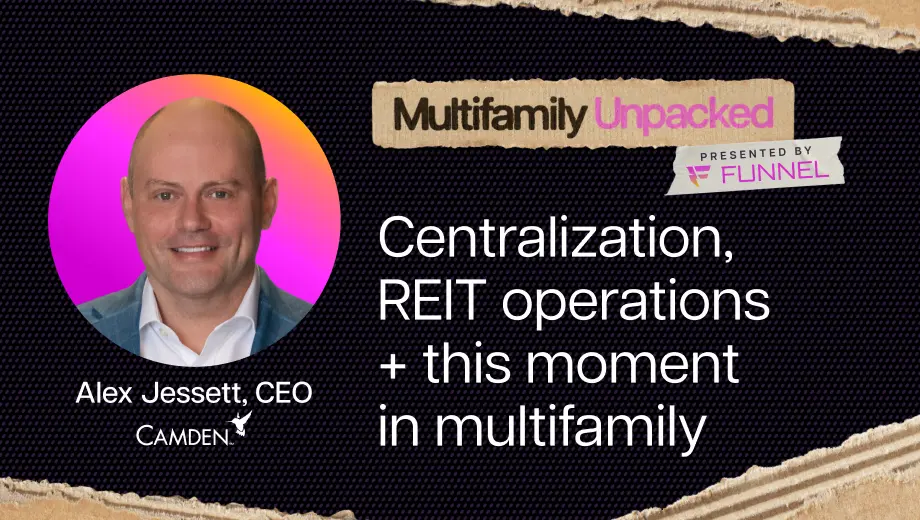
In this episode of Multifamily Unpacked, Tyler Christiansen, CEO of Funnel, sits down with Alex Jessett, CEO of Camden Property Trust, at Camden’s Houston office. They discuss how Camden’s centralized operating model supports innovation, and why a recognizable brand creates lasting value for residents, team members, and shareholders.
Jessett also shares how Camden approaches change management, builds trust during periods of technological transformation, and helps team members understand the connection between their daily work and the company’s financial performance.
In this episode
- How Camden balances the stability of scale with the ability to remain nimble
- The role market density plays in referrals and resident retention
- Why approximately 7% of Camden residents have previously lived at another Camden community
- How the Camden brand and hummingbird identity reinforce a sense of home
- Why putting Camden’s name on every community creates pride and accountability
- How centralization has affected team member tenure and morale
- Why successful change management starts with the people closest to the problem
- How Camden communicates financial performance to team members
- What renter-centricity means from an owner and operator’s perspective
- Why happy team members are a value Camden refuses to compromise
About the guest
Prior to his current position as Chief Executive Officer, Alex Jessett served as Camden's President and Chief Financial Officer, responsible for Finance, Capital Markets, Real Estate Investments, Construction, Accounting, Operations, and all Operations-related teams. Since joining Camden in 1999, Alex has held various roles and has been responsible for over $25 billion of debt and equity issuances and structured real estate transactions. Before joining Camden, Alex began his career in real estate at Comerica Bank of Texas in the Real Estate Lending department.
Listen to the full conversation wherever you get your podcasts, or read the full transcript below.
Introduction
Welcome back to “Multifamily Unpacked.” Today’s special episode is with Alex Jessett, the new CEO of Camden Property Trust. In this episode, we visited the Camden office in Houston, Texas, talked about Alex’s history in the industry, the history of Camden, and, most importantly, the intersection of culture, operations, and technology.
What really struck me from this conversation is that I have met with multiple leaders at Camden over the years, and there is a consistency of purpose in everything they do. Whether it is technology, HR, values is tied to a consistent theme and a mission to serve their renters.
Centralization, scale, and agility
Tyler Christiansen, CEO of Funnel: Camden has created a culture of technology leadership. You are ahead of the curve. You have built and sold multiple technology products that you brought to the industry. Funnel is just one of those. Although, I will say, I complained earlier that we do not have a conference room yet, so we have work to do.
Alex Jessett, CEO of Camden Property Trust: We need to do that.
Tyler Christiansen, CEO of Funnel: Yes, we have work to do. There is a Bacon conference room and a Chirp conference room. We need a Funnel conference room.
Alex Jessett, CEO of Camden Property Trust: Yes.
Tyler Christiansen, CEO of Funnel: One of the huge innovations at Camden came as you entered the public market, probably around the time you were joining the organization. You shifted to operating the portfolio from a single balance sheet, not just for asset management, but also for operations. You started thinking about operations and asking, “How can we take advantage of economies of scale?”
That has been a differentiator. When we think about things like COVID, you were ready to pivot because you had the contact center. With AI, you were one of the first companies to genuinely find cost savings, without making arbitrary cuts, because the work was already aggregated.
As you come into this role and look at the history of running Camden as a portfolio, you look more like Tesla, with a singular brand, than Ford, where each individual dealership is separate. There is a lot of talk about growth and how to build on your portfolio size. How do you envision leaning into the density you already have in your markets, and the centralized head start you have against your competitors? Is it a matter of continuing to work with what is already working, or is there a next version of centralized operations that you are thinking through?
Alex Jessett, CEO of Camden Property Trust: There is a lot there, so let’s unpack that for a minute. Some of the key points I heard you make relate to size, so I will address size first. It is especially relevant right now because two very large multifamily REITs just announced a merger.
Tyler Christiansen, CEO of Funnel: I heard about that.
Alex Jessett, CEO of Camden Property Trust: There has been a lot of conversation about whether you need to be bigger. I have been very clear about this: bigger is not better, better is better. That is point number one. When you think about total shareholder return, I have yet to see any analysis showing a correlation between how big you are and your long-term total shareholder return. In fact, I would argue that the correlation is probably inverse. Once you get too big, think about it like a battleship. It takes a lot to turn a battleship. You can turn a speedboat much more easily. With Camden at the size we are today, we are an S&P 500 company. Depending on our stock price, we are a $16 billion company. We are big enough to have stability and scale, but small enough to be incredibly nimble. It does not take a lot of developments for us to create alpha for our shareholders. It does not take a lot of technology investments and great technology partners to create alpha for our shareholders. I think we are at the right point in time and the right size to be highly efficient and really nimble. That is point number one.
Point number two is that it makes sense to have scale in a community. If you think about what we do, we try to maintain a good split between Class A and Class B communities, and between urban and suburban communities. The reason is that we know there are different customers for different product types.
Brand value and renter loyalty
Quite often, a customer will tour one of our communities, and that community is not right for them because of the price point or the amenities. It is easy for us to say, “We have one right over there. Go check out that one.” We see a tremendous number of referrals like that.
The same thing happens because of the Camden brand. By the way, I believe the Camden brand is the most recognizable and valuable brand in the multifamily business. Because that Camden brand exists, we have people who live at a Camden community and, when they move to another city or state, look for another Camden community. It is like the people who say, “I only stay at Marriotts.” In this case, it is, “I only rent from Camden.” There are so many people like that.
Tyler Christiansen, CEO of Funnel: I am going to give you some data to back that up. A couple of years ago, while introducing what we call the renter-centric® architecture, we realized we could actually quantify this.
We looked across our operating portfolio. We are very fortunate to work with a lot of large operators, although you are our favorite. We were mostly trying to prove to people that renters care about brand and are willing to stay within a portfolio. Among our customers with more than 30,000 to 40,000 units, so roughly the NMHC Top 50, we found that, on average, about 3% of their existing residents showed up on the ledger as a past resident of another community in the same portfolio. I do not know if this statistic ever made it to you, but Camden led the pack. It was about 7%. About 7% of Camden residents are essentially alumni. They selected another Camden property and came back to the brand.
This was not one of my scripted questions, but I have to ask. One of the things I love, and something I told Kristy as I was walking around the building, is how much you care about the brand. You represent the brand colors. People are proud to wear the Camden shirt.
I was thinking that if I visited Camden Brandon or Camden Westshore, two of these beautiful properties you have in Tampa, team members from those communities could come into this building and feel that this brand is their brand.
Alex Jessett, CEO of Camden Property Trust: Absolutely.
Tyler Christiansen, CEO of Funnel: They do not think of themselves as working at Arbor Villas or another stand-alone property name. That is unique. You just mentioned a merger happening in the industry. To my knowledge, there certainly was not a singular brand across Equity or across AvalonBay. There were sub-brands, and now they are introducing a new name and a new brand.
You have done this work over, I assume, decades. It probably comes at a significant capital expense to go in and rebrand a property. I just shared a statistic showing that residents return to Camden at more than double the average rate, so it certainly is not serendipitous. Why do you feel it is so important that, from the corporate office here with the beautiful hummingbird statue to Camden Central in St. Petersburg, that logo is prominent and means something to you? Where does that conviction come from?
Alex Jessett, CEO of Camden Property Trust: The first thing you have to know is that Camden did not used to be branded like this. We rolled out the hummingbird about 25 years ago, and we spent a lot of time and did a lot of research before we did it.
The reason we picked a hummingbird is that, if you actually look at hummingbirds, they always return home. By the way, I did not know the statistic you just gave, but it shows that our hummingbird residents are always returning home. They are always returning to Camden.
Tyler Christiansen, CEO of Funnel: We should look it up again. That statistic is old. I bet it is higher now.
Alex Jessett, CEO of Camden Property Trust: When you put your name on something, it means something, and you have a tremendous amount of pride around it. You work at Camden, and that is special. I come across so many people who say, “You work at Camden. I lived in a Camden,” or, “My friend worked at a Camden,” or, “I worked at a Camden.” It means something very different from saying, “I work at The Park at whatever,” or another name with no broader identity.
It has become so important. When we put our brand on something, there is an expectation for customer service and customer experience, and our team members know that. More importantly, our team members have so much pride in what they do that they want to live up to that expectation and surpass it. It is a beautiful thing.
Here is an interesting statistic to consider. We have been around for 33 years. We have about 100,000 people living in our communities right now, and we turn over 50% every single year. That means well over a million people have lived in a Camden residence. It is so important that they associate Camden with something of a high standard because they then become referrals to everyone else. They say, “I lived in a Camden. It was great. You should try a Camden.”
Tyler Christiansen, CEO of Funnel: That is basically one out of every 300 people in America who has come through a Camden door and is proud of that. Of course, we like to associate ourselves with that name. It is interesting because, when I first came into multifamily, I believed in my heart of hearts that there was room for a more preeminent brand in the industry and for everyone to own up to it. I still believe that.
The answer I usually hear for not doing that has played out in some ways over the last couple of years. We have seen an environment of litigation. Companies say, “We do not want people to know who manages this community. We do not want bad Google reviews tainting our name. We do not want the potential risk.”
You also have your values on the wall. People often say, “Do not put your values on the wall. You have to wear them on your sleeve.” First of all, I know your values. Your team lives the values. They are in the book, and they are in everyone’s behavior.
But your values are literally three-dimensional. I do not know if that was an intentional choice. I know you said you played designer for the office, but I have never seen that before, and it was not lost on me. They are not just flat against the wall. They are substantive values.
You and the leadership team at Camden strike me as people who would say, “We want you to review us. If we are doing poorly, we want to know about it. We stand behind our business practices because we operate with integrity. We are not afraid of you knowing our name, knowing how to sue us, or knowing how to write a negative review, because that holds us accountable.”
Alex Jessett, CEO of Camden Property Trust: If you are proud of something, you should brag about it. We are very proud. But I do have to point out that Amy Funk, who works for us, did most of the design work. She is the superstar.
Tyler Christiansen, CEO of Funnel: Good job, Amy. I love it. It is a beautiful office.
Culture and change management
Tyler Christiansen, CEO of Funnel: You mentioned the pride of the Camden brand. There are a small handful of multifamily companies that have what sports fans would call a coaching tree. When I think about leaders like Tom Sloan at Windsor, Marcie at Bainbridge, Joy at Pavesi, and many other wonderful leaders, there is a long list of people who tie back to Camden. I would also name Archstone as one of those organizations. You find a lot of former Archstone people leading in the industry
The kind of tenure you have established is clearly incredibly important to the team. You have also talked about being named the best place to work in the country.
Centralization is another part of this. There was a point when you established the contact center and moved from saying, “We have site teams, and we have the centralized team,” to saying, “We are all part of the centralized model.” We are all moving into nests, to keep the analogy going. I am curious about that change management. One of the things I always joke with Kristy about is that I will call her, and she will say, “Where are you today?” I will say, “I am in Boston teaching people what you did five years ago.” This is still a very popular topic.
A lot of your peers, whether they are public REITs or private companies, are still trying to make the transition from purely property-based operations to centralized communities. The number one reason people are slow to make that change is the change management and the perceived negative impact on morale.I have had the chance to get to know Allison Dunavant (SVP Human Resources) who leads your HR team. The data she has shared in multiple settings shows that, yes, there was some change management pain, but you have better tenure now than you did before.
Returning to this theme of Camden and people being proud to wear it on their shirts, I am curious about moments like your last all-hands meeting, when you said, “We are embracing AI.” How do you instill confidence so people trust you when you are crossing that chasm and do not know exactly what the outcome is going to be?
Alex Jessett, CEO of Camden Property Trust: You identified it. This is a high-trust business with our residents, and it is an even higher-trust business with our team members. Your track record has to show that what you are doing is for the betterment of the team. If you have a good track record, that is paramount.
This is why it only takes one mistake to blow up 33 years of everything good you have ever done.
The other thing I will return to is a comment I made earlier. We fundamentally believe that the best decisions for solving any problem come from the people closest to the issue. Whenever you are doing any type of change management, first of all, most of the time the idea came from someone in the field, on the team, who is living it. The second thing is that we engage with those people as true partners, because they should be partners.
They are the ones who are going to have to live with any decisions we collectively make. They are the ones who are going to have to execute whatever initiative we are pursuing. We have to make sure they feel like partners, feel trusted, and feel heard.
Finance, transparency, and trust
Tyler Christiansen, CEO of Funnel: Understood. I am going to end this segment with one question. When I first got to know you, Alex, it was through the lens of an investment opportunity. Of course, I am happy to know now that you thought it was a good investment, because at the time, I was not sure. You did a good job. You negotiated well.
Leadership in multifamily, and increasingly leadership of multifamily REITs, has a finance orientation. I came into multifamily understanding that. My father is a finance person. That is how I got into multifamily. He views them as assets. I view them as communities.
How do you think about earning trust when FFO has to be part of every conversation? At times, people view those two things as separate. They might say, “I have a great technology initiative, and you are asking me about ROI. How do I reconcile those?”
You are trying to build a culture of trust with your residents, but you are also trying to find rent increases where you can find them. You are trying to build a culture of trust with your team members, but you are also trying to improve FFO where you can find it.
How do you balance those things as a CFO turned CEO? I have met other CEOs of multifamily companies who view their job as being the person who encourages everyone. But you are the CEO of a publicly traded REIT, and you have to be financially minded as well. How do you balance those two things, maintaining trust while being transparent that you are running a for-profit business?
Alex Jessett, CEO of Camden Property Trust: The first thing is that the reason you see so many finance people serving as CEOs on the REIT side is that this is an incredibly capital-intensive business.
We borrow billions and billions of dollars. We have to understand how all of that works and how it flows through the business. One of the things we started to do was take the key points from our quarterly earnings calls and push them out to all Camden team members. It was not originally my idea. I cannot remember whose idea it was, but I would certainly give them credit if I could remember. We wanted team members to understand exactly why what they do directly influences our returns and directly influences what we put out to the Street. About six or seven years ago, I started doing these quarterly videos. They are short, about five or six minutes long. I used to laugh that I was trying to be a YouTube star, so maybe you can help me become more of a YouTube star.
Tyler Christiansen, CEO of Funnel: I would love to.
Alex Jessett, CEO of Camden Property Trust: We put these videos out every single quarter, right after we release earnings.
Some people used to give me grief and say they were incredibly boring. I think they have gotten better. They probably were boring in the beginning, but they have improved a little bit.
We get tremendous engagement. I will tell you, the coolest thing in the world to me is when I go on site and a leasing agent starts talking about our debt-to-EBITDA ratio. I think, “Oh my gosh. This is amazing.”
Or one of our construction team members will say, “I really loved how you called out that our fee income on the construction side was adding to FFO.” I think, “This is so awesome.” It is transparency. It is communication. It is being an open book. That is exactly what you have to do.
Tyler Christiansen, CEO of Funnel: I love that. I have found something similar. The more you treat everyone like adults and bring them into the conversation, it is not a secret anymore. You can say, “This is how we are performing.” I think it is also a bit of a sorting test. Your top performers love it. They feel engaged in the business. To your point, that is where those ideas come from, the field.
What renter-centric means
Tyler Christiansen, CEO of Funnel: Alex, I want to be respectful of your time. We are going to wrap with a couple of speed-round questions. Funnel has a tagline that we use: renter-centric®. We say, “We are Funnel, and we are renter-centric®.” We are talking about our architecture and how, in Funnel, you create one record even if someone is considering one to three Camden communities. It is part of your centralization model.
When you hear the term renter-centric, what does it mean to you?
Alex Jessett, CEO of Camden Property Trust: Renter-centric® is obviously going to mean something different for us than it does for Funnel.
We believe that we exist to improve the lives of our team members, our residents, and our stakeholders, one experience at a time.
Let’s break that out and focus on our residents. We fundamentally believe that we are there to improve their lives. We are there to provide housing. Housing is an incredibly noble thing to provide.
One of the things I know, and something that really helps us recruit team members, is that people want to do something that makes a difference. Providing housing is an incredibly important and wonderful thing to do. This is the place where memories are made. This is where experiences happen. This is where friendships are born. We take tremendous pride in making sure that the experience for our residents is of the highest standard and that they feel like this is their community.
Twenty years ago, we said, “We are no longer going to call it an apartment. It is a community.” We do not call them units. They are homes, because they are homes. Our focus is on making sure that the experience for our residents is the best it can be. That is why we have such fantastic renewal percentages and, apparently, so many alumni returning to us.
Tyler Christiansen, CEO of Funnel: That is right. For anyone listening, executives often like to talk in big-picture terms, but I got to witness this firsthand. An intern just stopped by the office, and I could see how excited she was about the opportunity to come back to work at Camden, which you invited her to consider. There is probably another podcast to record about the cookie ritual, but we probably do not have time for that.
What is a value that you or Camden refuse to compromise on?
Alex Jessett, CEO of Camden Property Trust: I would say the idea that everything starts with happy team members. That is the most important thing.
Tyler Christiansen, CEO of Funnel: I love that. In this day and age, when there is constant cost pressure and technology pressure, that has shown up for you. I know Camden has philanthropic causes. Funnel has a philanthropic cause called HOME, for those who are not familiar.
You have two college-aged students, so I am sure you think about spending more time with them. But if we waved a magic wand and said, “You have had a successful tenure as CEO of Camden, and you have handed the baton to someone else,” what philanthropic cause motivates you so much that, if you could work on it from nine to five, you would?
Alex Jessett, CEO of Camden Property Trust: Rick Campo, one of our founders, and Keith as well, are both very philanthropic. They got me engaged. You can look at my résumé and see that I do a lot of things, but the one thing I am most passionate about is education.
I fundamentally believe that if you start with someone when they are young and give them the appropriate education, you not only change their life, you change the life of their future spouse and the lives of their children’s children. The best way to make an immediate impact and absolutely change the trajectory of the most people is through education.
Tyler Christiansen, CEO of Funnel: I could not agree more. I know that Camden, the associations you participate in, Funnel, and the different organizations we work with all support that. Entryway is a great one that we really value.
Alex, thank you so much. Thank you for the support for Funnel. Thank you for the example Camden has set for the industry, and thank you for your time.
Alex Jessett, CEO of Camden Property Trust: Absolutely. I really appreciate it. I appreciate it so much.