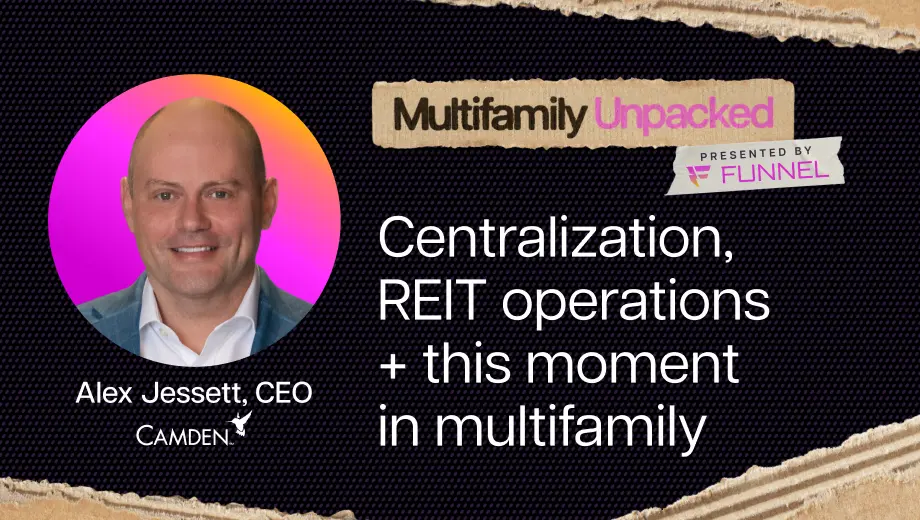
In this episode of Multifamily Unpacked, Tyler Christiansen, CEO of Funnel, sits down with Alex Jessett, CEO of Camden Property Trust, to discuss the company’s approach to artificial intelligence (AI).
Jessett explains why multifamily may be difficult to disrupt, but is still full of opportunities for AI to improve the resident and team member experience. For Camden, the goal isn’t to remove people from the leasing journey. It’s to automate mundane work, help team members perform at their best, and give customers the freedom to interact with Camden in the way they prefer.
The conversation explores Camden’s early investment in Funnel’s AI, how the company evaluates the return on new technology, and why AI’s value extends far beyond reducing labor costs. Jessett also shares Camden’s “leadership, crowd, and lab” framework for developing scalable AI use cases, and explains why culture will ultimately be the company’s greatest competitive advantage.
In this episode
- Why multifamily is more resistant to disruption than other real estate sectors
- The importance of maintaining trust and human connection in the resident experience
- How technology can complement—not replace—onsite team members
- Why Camden invested in AI before the rise of generative AI
- What Gen Z’s preferences reveal about the continued value of human interaction
- How Camden balances self-service options with personalized service
- Why the ROI of AI shouldn’t be measured solely through headcount reduction
- Opportunities for AI across renewals, maintenance, insurance, and other operating areas
- Camden’s “leadership, crowd, and lab” approach to AI experimentation
- How happy team members lead to happy customers—and ultimately happy shareholders
- Why culture, rather than any individual technology, is the real differentiator
About the guest
Prior to his current position as Chief Executive Officer, Alex Jessett served as Camden's President and Chief Financial Officer, responsible for Finance, Capital Markets, Real Estate Investments, Construction, Accounting, Operations, and all Operations-related teams. Since joining Camden in 1999, Alex has held various roles and has been responsible for over $25 billion of debt and equity issuances and structured real estate transactions. Before joining Camden, Alex began his career in real estate at Comerica Bank of Texas in the Real Estate Lending department.
Listen to the full conversation wherever you get your podcasts, or read the full transcript below.
Introduction
Welcome back to "Multifamily Unpacked." In today's episode, I sit down with Alex Jessett, the new CEO of Camden Property Trust. We visited Alex in the new Camden office in Houston, Texas. In this episode, we focus on Alex's point of view on AI. Unsurprisingly to anyone who has heard a Camden leader speak, the company is aligned with Funnel on the need to keep the human in the loop.
We dig deep into AI initiatives, the journey Camden has been on, and some of the lessons the company has learned while experimenting with different technologies. AI will be part of operations going forward for Camden and every large real estate operator, so I hope you enjoy this conversation.
AI and the human-centered customer experience
Tyler Christiansen: All right, Alex, thank you so much for being on with us. A beautiful new office here in Houston. I know last week was earnings call week, so I'm going to do my best to pretend to be an analyst and ask you questions that are on my mind. So on the recent Jay Parsons podcast, big fan of his, you mentioned one of the things you love about the real estate vertical is that it's a vertical that's hard to disrupt, right?
And so obviously Camden has a history of investing in disruptive technology, including Funnel, but, as you think about your use of technology and all that's changing in the world of AI right now, you know, where do you think about how much that's going to disrupt Camden, the team members, kind of how you run your business, especially as you're taking over, a REIT that has a long history of success?
Alex Jessett: Yeah, absolutely. So the first thing you have to know is when we're talking to Jay about disruption, we're talking about the fact that if you look at other real estate sectors, take retail. Retail was completely disrupted by the internet. The office sector was disrupted by Teams and Zoom and the ability for people to work from home and no longer go into the office.
Hotels and business travel were disrupted by the technology that allowed people to have really good meetings where they can see one another. Multifamily is very different from that because there's no way that you can digitize a bed. You must have a place to go to sleep.
That is what I was focusing on in terms of technology and disruption. Now, if you start to think about where we can do some fun things in multifamily, I absolutely think AI has tremendous opportunities. I will tell you in the analyst and investor world, a lot of people ask me about AI and I think I'm known to really run with it because I'm so fascinated by this.
I'm so excited by the potential. But the one thing that I want to point out is that when we start to talk about the potential, what we cannot forget is that multifamily in particular is a high trust business. And a high trust business means that person-to-person communication, that human interaction can never go away.
And where I think a lot of people make a mistake when they start to think about technology or they start to think about AI, is this idea that somehow we're going to get rid of every human. And I have to tell you that if I was a renter and I went to an apartment community and there was never anybody there, I think that would be a very different and, quite frankly, a really disappointing experience as compared to if I go to an apartment community and I see a friendly Camden team member there, and that Camden team member asks me about my day, and that Camden team member is making sure that I have the best possible experience, and I walk out into the yard and I see a Camden maintenance person, and the Camden maintenance person says hello, et cetera. That's what builds a sense of community.
Number one, you have to maintain that human high-trust experience. That is point number one. Point number two is that, you can have an amazing customer experience also using technology. And the example that I always use on this one, and it's such a simple example, but I always say, "When was the last time you got a debit card in the mail?"
So you get a debit card in the mail, and I'm old enough to remember that when you got a debit card in the mail, you had to go to the bank to activate it. Today, what do you do? You look at the back of the debit card, you call this number, and it says, "Your card is now activated."
You hang up and say, "That was a great customer experience."
There was no human involved whatsoever. So there are opportunities like that, but those opportunities should do nothing more than augment what our humans are doing, right? If we can find ways that we can take a lot of the mundane work away from the humans, use technology, and then let the humans do what they do best, which is provide this wonderful experience, that makes a ton of sense to me.
If we can use AI, and I know that, I know your company's named Funnel, but I always say if you can use AI at the top of the funnel all the way down through every single aspect to help our folks in the field, that's what I'm really excited about.
Camden's early investment in AI
Tyler Christiansen We are going to blow up the script right away because there are several things you said there I want to unpack.
So let's use this differentiation of the Camden model, and there are some decisions that you just mentioned that, for folks that don't really understand how you versus other properties operate, they're going to be lost on them, so I'm going to go back. So first and foremost I alluded to it, but I'm going to give Kristy Simonette, SVP – strategic services and CIO, leads technology here at Camden, just gave me a tour of your beautiful office, and one of my favorite quotes in running Funnel ever has been, "You all are 90% the perfect product."
And that's what Kristy told me at your old office here in Houston when we showed the centralized CRM. That was a big deal to Camden. You already had contact centers, and there was an opportunity to think about them differently. But what she told us was, "But you're missing the opportunity, which is automation. There needs to be AI in this." And at that point in time, this was pre-ChatGPT, pre-generative technology, it actually wasn't easy to find funding to build an AI product. And so for those who don't know we put out a press release, but the reality is Camden funded Funnel's AI development because you all believed in it. And you believed in it beforehand. So maybe let's go back in time there, because then I want to unpack some of the differentiated things you mentioned. But do you recall, or maybe just going back in time, as you just articulated, Camden's always been people first. It's always been, you put your name on the building, you put your name on the polo.
You guys are proud of the experience that you deliver. So what drove the belief that you needed to use AI, at least in 2021, when it wasn't obvious to everybody why you needed to use AI?
Alex Jessett: The first thing is that, as you mentioned, Kristy Simonette is a wonderful visionary. I give her a ton of credit for coming to us and saying, "This is really how we should be thinking about the world," right?
The interesting thing about multifamily, I used to always tell people that multifamily is much like retail, but 30 years behind. Multifamily, to me, on the technology side, on the innovation side, had a long way to go. We were absolutely thrilled to invest. I still believe it's going to be a great investment. That was the thought process, right? You have to keep evolving.
Once again, I come back to the fact that I've been in this business for almost 30 years, and 30 years ago, the way you found an apartment community was you picked up an apartment book from stands across the city, and you flipped through the book, and you said, "Okay, this is where I want to go look." Can you imagine if we had never changed from that?
That would've been so completely inefficient. And so we have to continually evolve, continually change, make sure that we're looking out there for every single opportunity. I am always going to keep bringing this back, though, to say what's different from Camden versus some of our peers or some of our competitors is some of them are trying to say, "Let's use technology, and let's make it so that we don't need to have any humans."
To me, that would be an absolute colossal mistake. One of the things that I look at closely is generational behavior. Generations are so important to us, and if you look at the new generations coming in, with Gen Z, one of the things that's really different about Gen Z than some of the other generations, Gen Z is going to the mall more than the generation before them.
Tyler Christiansen: I have two teenage daughters. They absolutely love the mall.
Alex Jessett: They love the mall, right? And so there's a lot of theories about why this is, and a lot of people think it comes back to COVID, right? We all spent a year and a half in our homes, not talking to anybody. By the way, I always thought I was an introvert, and then I spent a year and a half in my house and I was like, "I really like people." I wanted to go find some people and get back to the office. And I think this particular generation craves being around people. And so I think for them, if they're going to come lease from us — and by the way, they are our future customer — if they're going to come lease from us, they want to talk to somebody, right?
We provide a fantastic self-guided tour option. The reality is most people would rather not do that.
Tyler Christiansen: You give them the option.
Alex Jessett: You give them the option.
Tyler Christiansen: And the data says they prefer it.
Alex Jessett: They absolutely prefer a human, and that's why you can't take that away.
Keeping humans in the loop
Tyler Christiansen: Now let's go to that exact point. COVID presented the perfect moment to say, "All right, we need to leverage the technology." You all, up until just very recently, were in states like California, right? You couldn't have a leasing office open. I think to your point, there were a lot of organizations that saw this inconvenient moment as an opportunity to eliminate humans from the leasing journey.
Now, to your point, Camden has, whenever and wherever possible, kept humans in the loop. That's the buzz term now in AI. And so talk to me about maybe some of those pressures you face. For those who do not know, Alex led the finance function. For those who are not as familiar, listeners to Jay's show know about FFO, a lot of our tech folks don't know what FFO is.
But you guys are constantly under pressure to look at that margin expansion and how to squeeze another dollar out. So I'm curious as you go back in time and think, "Hey, the AI's working." That was something very early that immediately we rolled out the AI, it was clear people were willing to book tours with it.
But when other competitors kept the leasing office closed, you guys kept it open. And so you talked about that is, core to the ethos of the Camden brand. I'm curious if there was really a lot of debate internally, because externally, and I have listened to your analyst calls, there are a lot of questions about that.
But when the time came, the technology was available, and it would've been, nobody would've judged you harshly for saying, "We're going officeless."
Keep in mind, for the listeners, Camden was also the furthest along on contact center. That is probably the core ingredient for going officeless, 'ecause the AI's going to capture, 30 to 60% of the interactions.
You have to have a centralized contact center, which we'll talk about in a bit. But anyway, I'm just curious internally here in the building, or the old building here in Houston, how much of a debate was it about, "Let's keep the leasing offices closed"?
Alex Jessett: Quite frankly, it wasn't much of a debate whatsoever. Our theory has always been you need to meet your customer where they are, and so the way we thought about it was we knew there was always going to be a portion of residents, we didn't know if it was going to be the minority or the majority we knew there was going to be a portion of residents who wanted human interaction.
So we said, "Okay, we're going to make sure we have that for them." Then we believed there was going to be a portion of people who said, "I'd rather just do this on my own." So what we said is, "Let's make sure that we have the very best self-guided option that you can come up with." And so we made sure that they were both there. Once again, not a lot of discussion.
Tyler Christiansen: I think that's the point. I assumed that was the answer, and for the minority of folks that are watching this on YouTube, there's this awesome book here that you guys put out earlier this year, Business As Unusual. It celebrates the founders, Rick Campo and Keith Oden, who have passed the torch on to you and other leaders, but when you read that book, you realize the culture's been instilled over decades.
Measuring the return on AI
Tyler Christiansen: We're talking about the AI journey, the technology journey and we'll touch on some more of that. I want to stay on this for a second, but looking ahead, so in kind of all walks of public investing, there is this tension, and this is, from the mega technology companies to brick-and-mortar companies, spend and ROI on that AI. I think there's really good productive conversations around that.
So you all have made this decision we're going to leverage technology. We are going to keep the human in the loop. I imagine that there are ongoing conversations now as you look out three to five years in the future. So five years ago, COVID happened, and you all deployed AI to provide a better human experience.
How are you thinking about this? There is no rent growth in most markets in America. AI spending, and technology spending in general, has increased, which we at Funnel are happy about. But how do you balance the tension between being a technology-first organization and a human-first organization when rent growth is not what any of us want it to be? How do you define the ROI of these technology investments?
Alex Jessett: I gave an all-Camden talk, both in person and by webcast, about two weeks ago. And it was all about AI, and I went through my perspectives on AI and the fact that AI is a tool to help make our existing humans better at what they do. Obviously, there's tremendous amounts of fear out there where folks believe that AI's going to replace them, and I said, "That's not what we're about whatsoever. We are not about finding AI and using it to eliminate humans." Now what I did say is that as time evolves, jobs will change. And I come back to the fact that when I first started at Camden 30 years ago, we had somebody whose full-time job was to manage the file room. This was a person who did nothing but hand you paper files.
And I said, “Obviously, that position's gone away, but now we probably have 10 people who manage electronic files.” These things always change, and they always evolve. So I laid this case out, and then I opened it up for questions, and one of our team members said "If you're not going to eliminate humans, how are you going to pay for all this AI?"
And by the way, I didn't plant that question. I love that question because that question. This is exactly the point that I've been trying to make to investors and analysts and team members, which is if you think about an income statement, and I'm not going to get into too much accounting here. If you just think about an income statement, you have all of your revenue line items, and then you have all of your expense line items. And I really believe that AI can improve every single line item, not just the salary line item. And for instance, if you can use AI to have a better understanding of the propensity to renew a lease of a particular resident, and if your use of AI improves your turnover by 100 basis points, that's millions of dollars to the bottom line.
If you move down to expenses, everybody in our world, we spend a fortune on repair and maintenance, right? If your AI could tell you exactly when the water heater should be going out or when the HVAC system should be repaired so that you can proactively get in front of that, that will save you millions.
If you can think about property insurance. Property insurance went from about 3% of our total expenses to about 7%. That's a doubling, and by the way, that was industry-wide. If you can use AI to understand exactly where the losses are occurring so you can get in front of those losses, that's millions. And by the way, nowhere in that discussion did we talk about salaries.
That's not part of it. In fact, I've made this comment a couple of times. At the risk of being a little bit aggressive, I almost think that when people start to say AI's going to cut salaries, I just think that's a lazy approach to think about it. I just think there are so many other options out there.
But you're right, there has to be return on investment, and that's one of the other things that we talk about a lot, right? Is if somebody comes to us and they say, "I'm using AI, and I have taken a process that used to take three weeks, and it can now be done in 15 minutes." This was a real-life example.
And when I heard about it, I said, "And?" I asked because our job with AI is to not make it so everybody only works 20 hours a week. Our job when it comes to AI is to say, "You can do your existing job better and more efficiently, therefore you can then go do something else that creates more value." That's the return on investment, right? And that's what everybody's looking for. And I'll give you Camden's perspective on this, and I addressed it on our last earnings call. I did not come up with these three words. I read it in an article.
I just happened to love the article. We adopted it and it became our approach. But what we say when it comes to AI is we have three focuses. They are leadership, crowd, and lab. So the first thing is, on the leadership side, we are encouraging all of our senior vice presidents and up that you must embrace AI. This is paramount.
So much so that we have created an AI steering committee, which is made up of every senior vice president and up. We meet once a month. We talk about AI, we talk about exactly what we're all doing. And that's fantastic because it's a great, it's a great way to make sure we're all on the same page. And one of the things that we talk about quite a bit is there must be a return on investment.
The next step is crowd. I firmly believe that the best people to come up with a solution to any problem is the people that are the people closest to the issue. So let's go to our crowd, and we've already done this. We've identified super users across the company, and super users are people that we thought were really creative, innovative, tech-savvy, and could really experiment with this and have fun. And we're saying, "Okay, crowd, go out there and see if there are some solutions that you can think of." And then once the crowd comes up with something, then they go back to leadership and say, "I think this makes some sense." The next step is lab.
We are in the process of building out what we're calling a lab, and the idea is this is where it's almost like a sandbox. This is where you can play with whatever technology's there, and you can make sure, number one, does it does your AI actually work?
Number two, is it scalable? Right? Does it make sense, et cetera. That is our entire approach to all of this, and I think that is, that approach will be a real differentiator for Camden.
Culture as a competitive advantage
Tyler Christiansen: I want to dig into that. I'm fascinated by this, and I'm fortunate to know a lot of folks at Camden. So as you were talking about these super users, I would imagine there are people like Danielle Rivers (Director of Business Services) who are very tech-savvy.
Alex Jessett: Absolutely.
Tyler Christiansen: My next question was going to be about differentiation, and you led me there when you said that there are competitors out there who believe that a humanless leasing experience is their model. One of the things that always comes to my mind is anybody can do that. Anybody could be Walmart and have terrible customer service. But then it becomes a low-cost battle, right? They're just competing on cost, and there's no differentiation. Would I be correct in assuming that the structure you just articulated, and again, having just gotten the tour, this is not simply lip service, it is literally written on your walls.
I saw a digital screen that had a quote from you and a quote from Laurie Baker (President and COO), about our AI strategy. You had Microsoft Copilot trainings that you were offering to your team members. It would appear to me that the differentiation is not going to be, Funnel or Copilot or any one product, but perhaps a culture where folks feel certainly AI literate.
To your point, you as a leader cannot be hands-off on this technology. You can't expect somebody else to tell you how Copilot or Claude work. But that culture reinforces the differentiation. We've got a lot of beautiful Camden properties in Tampa. My favorite one is right by the Rays Stadium, the current Rays Stadium Camden Central. And that Camden Central team member isn't sitting here in Houston. They're not necessarily seeing that. But the culture that's being embedded by having leadership hold an all-hands meeting, by having, folks like Danielle be visible in the tests that they're running, all of that ends up being the differentiation of how Camden's AI strategy plays out. Is that it? Or do you think you guys have a unique point of view on certain tooling?
Alex Jessett: No, I think it's the culture. I will tell you this: we just had our earnings call last week, and one of our sell-side analysts put out a piece. And by the way, I never thought a sell-side analyst would ever say this, but a sell-side analyst put out a piece about our Hummingbird culture. Obviously Hummingbird is our brand.
And the point that they made was the Hummingbird culture is what differentiates Camden from the community across the street, and this is why Camden will outperform. When you start getting sell-side analysts to pick up on this…
Tyler Christiansen: That’s high praise.
Alex Jessett: That is absolutely phenomenal. It is so logical to think about, right? when we first became one of the we're named by Fortune as one of the best 100 companies to work for in America.
Tyler Christiansen: Form many years in a row.
Alex Jessett: Many years in a row. But when the list first came out, we noticed that there was another company in Houston that was on the list, and it was Methodist Hospital. We thought about this for a second, and this was the perfect analogy for us, was this: if you had to go to the hospital, would you rather go to a hospital where the nurses and the doctors and the orderlies loved their job? Or would you rather go to a hospital where the staff hated their job? Clearly, when they love their job, they're going to give you better service, right?
It's going to be a better experience. It's the same thing at Camden, right? If you go on site and our folks love their job, you're going to see it. You're going to recognize it, right? Our theory is that we start off with happy team members, and we believe if you have happy team members, that will lead to happy customers, and then the happy customers will lead to happy shareholders.
It has to start with happy team members. What so many companies get wrong is they start the backwards way. They say, "I'm going to focus on making sure we have happy shareholders." But you're not going to get there unless you have these other two items. It is 100% our culture. It is the way we treat our humans, and that is the differentiator.
Tyler Christiansen: I couldn't agree more. To your point on investment, we're incredibly grateful to have you on our cap table, but I have always felt from Camden, whether it is Kristy, Danielle, or Alison, there's a shared technology partnership vision, but it has always been similarly about the partnership, about the people, and then how we support each other.
I've always thought in our world, I look at a lot of things like Glassdoor, and it's a forward-looking indicator. We've had competitors perhaps growing faster than us at times, but when you start to see that cultural erosion, it's only a matter of time before that comes through in the performance of the business.
Alex Jessett: Absolutely.
Culture is everything
Tyler Christiansen: I have to look up that article. All well, we're going to work in a couple of speed round questions. We're about to transition to the operational side, but normally I do these interviews sitting in my office in Tampa, and we've got this billboard sitting outside.
We're not on the 28th floor in Tampa, we're on the second. And so I like to ask folks, and I often think about what would I put on that billboard? What kind of Funnel mantra or just Tyler mantra? Alex, if we had a billboard sitting outside your office here in Houston, what is an opinion? It could be multifamily related, could be about the Longhorns, your alma mater. What's an opinion you feel so strongly about that you'd put on a billboard?
Alex Jessett: Culture is everything.
Tyler Christiansen: Perfect way to end that segment.